 History Globe
town or village
Amphipolis
Lifetime: 437 BC – …
Founded by Athenian colonists under Hagnon on the Strymon, at the place called Nine Ways.
History
Amphipolis stood on a hill on the east bank of the Strymon in Macedonia, a few kilometres above the river mouth and its port Eion, near the timber and the gold and silver mines of Mount Pangaeus. The place was first called Ennea Hodoi, the Nine Ways. Herodotus says that when Xerxes' army crossed the Strymon there in 480 BC, the Persians buried alive nine boys and nine girls of the local people. About 465 BC an Athenian colony was sent there, but the settlers were cut off by the Thracians at Drabescus.
In 437/436 BC the Athenian Hagnon founded the city and named it Amphipolis because the Strymon flows round it on two sides. In the winter of 424 BC the Spartan Brasidas took it; the historian Thucydides, then an Athenian general at Thasos, came too late to save it and spent twenty years in exile. In 422 BC Brasidas and the Athenian Cleon both fell in a battle before the city, and the Amphipolitans buried Brasidas in the city and honoured him as their founder in place of Hagnon. Philip II of Macedon took Amphipolis in 357 BC. After Alexander's death, Cassander kept Alexander's widow Roxane and her young son in its citadel, and about 310 BC he had them killed.
After Rome defeated Perseus, the last king of Macedon, in 168 BC, Aemilius Paullus announced the settlement of Macedonia at Amphipolis: the country was divided into four regions, and Amphipolis became the capital of the first. The city lay on the Via Egnatia, and Paul and Silas, going on from Philippi, "passed through Amphipolis and Apollonia" to Thessalonica. Acts says nothing of a stay there.
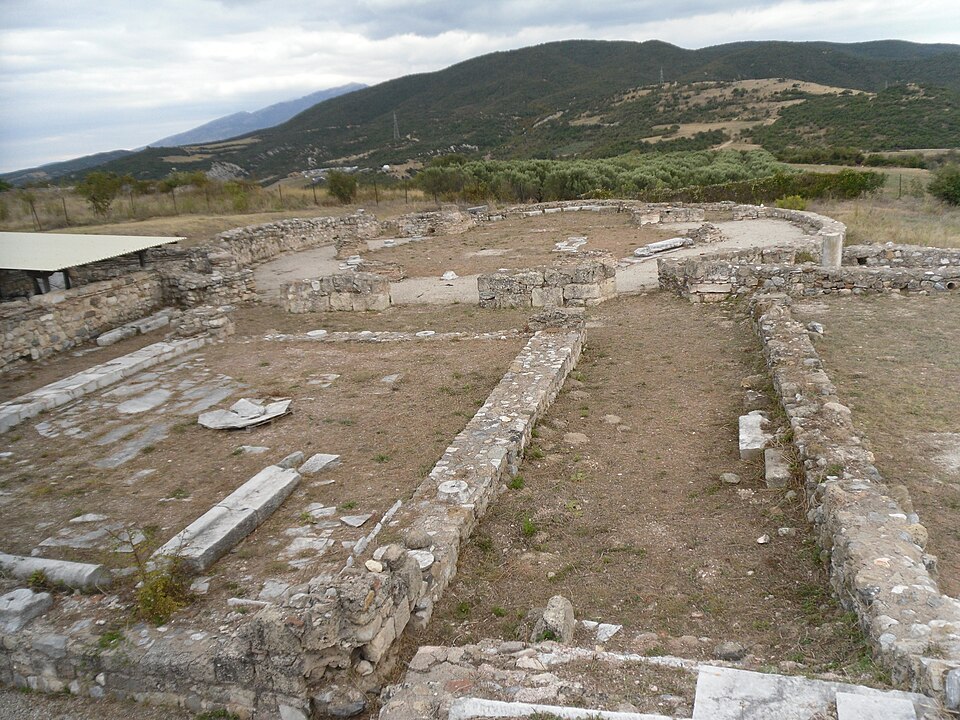
In late antiquity the inhabited city shrank to the walled acropolis, where several basilicas with mosaic floors and a church with a hexagonal plan were built in the fifth and sixth centuries. Greek excavations, led for many years by Dimitrios Lazaridis, uncovered the walls, the gymnasium and these churches. Near the river stands the colossal marble Lion of Amphipolis, a funerary monument usually dated to the fourth century BC.
Scripture: Acts 17:1
Sources
- Herodotus, Histories 7.114
- Thucydides, History 1.100.3; 4.102-106; 5.10-11; 5.26.5
- Diodorus Siculus, Library 16.8.2; 19.52.4; 19.105.2
- Livy, History of Rome 45.29
- M. H. Hansen and T. H. Nielsen (eds.), An Inventory of Archaic and Classical Poleis (2004), s.v. Amphipolis
- N. G. L. Hammond and G. T. Griffith, A History of Macedonia, vol. 2 (1979)
Checked against its sources; not yet read by a historian.
Verses (1)
- Acts 17:1
- Now when they had passed through Amphipolis and Apollonia, they came to Thessalonica, where was a synagogue of the Jews:
King James Version