 History Globe
town or village
Beth-shan
- Today Tel Bet Shean
Events
- c. 1294 BCSeti I campaigns in Canaan and sets up a victory stele at Beth-shan
- c. AD 749An earthquake ruins Scythopolis (Beth-shan), Pella, Gadara and Tiberias
History
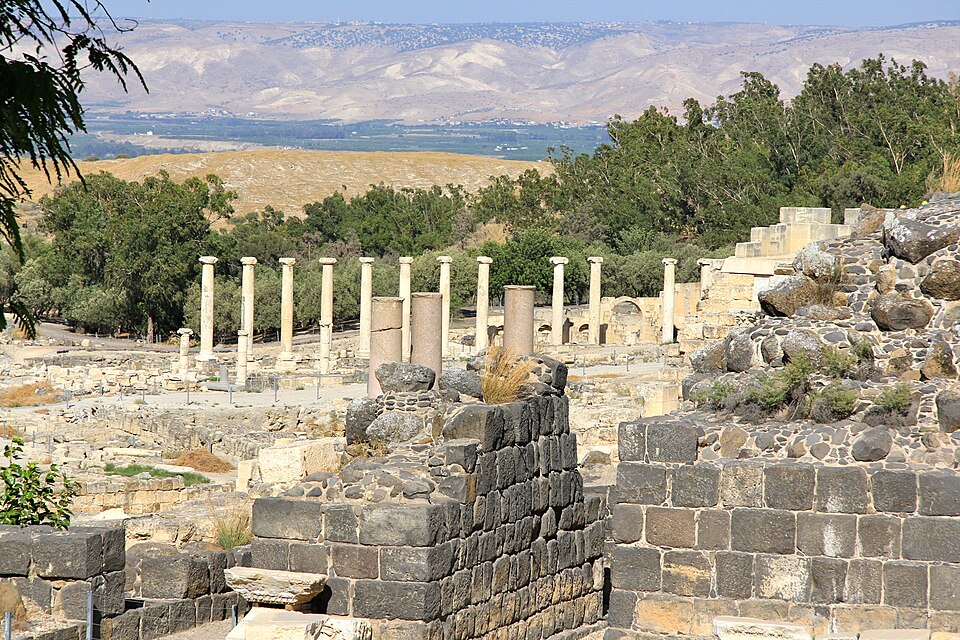
Beth-shan stands on a high mound, Tel Beth-Shean, where the Jezreel Valley comes down past Mount Gilboa to the Jordan Valley; the Roman and Byzantine city of Scythopolis spread out at its foot. The mound was settled by the fifth millennium BC. Thutmose III named Beth-shan in his list of Canaanite towns at Karnak in the fifteenth century BC, and in an Amarna letter Abdi-Heba of Jerusalem complains that the men of Gath had a garrison in Beth-shan. The University of Pennsylvania, digging here in 1921–1933, found basalt stelae of Seti I and Ramesses II from the time when Egypt held the town; one tells how Seti I sent an army division to Beth-shan when the ruler of a nearby town tried to seize it.
Beth-shan was assigned to Manasseh, but the tribe did not drive out its Canaanites, whose chariots of iron the children of Joseph feared. After Saul and his sons fell on Mount Gilboa, the Philistines put his armour in the house of Ashtaroth and fastened his body to the wall of Beth-shan; the men of Jabesh-gilead went all night and took the bodies down, and David later took the bones from them. Under Solomon the town belonged to the district of Baana, and Pharaoh Shishak listed it at Karnak among the towns of his campaign in the late tenth century BC. The Iron Age town ended in fire in the eighth century BC, usually tied to the Assyrian conquest of 732 BC.
In the Hellenistic age the place became a Greek city, Nysa-Scythopolis; a Seleucid town on the neighbouring hill of Tell Iztabba was founded under Antiochus IV. Pliny explains the name Scythopolis by a colony of Scythians, but its origin is disputed. According to 2 Maccabees, the Jews of Scythopolis testified that its people had treated them kindly, and Judas and his men thanked them and went on to Jerusalem. About 107 BC the city was betrayed to the forces of John Hyrcanus. Pompey freed it from Jewish rule in 63 BC, Gabinius rebuilt it, and it was counted among the cities of the Decapolis; Josephus calls it the largest of them.
When the war with Rome broke out in AD 66, the Greeks of Scythopolis turned on the Jews who had fought on their side and, Josephus says, killed more than 13,000 of them. In AD 67 Vespasian gathered his legions there before marching on Tiberias. The Roman city had colonnaded streets, a theatre and baths. Eusebius calls it a famous city of Palestine, and by the early fifth century it was the chief city of the province of Second Palestine.
Scripture: Josh 17:11; Josh 17:16; Judg 1:27; 1 Sam 31:8–13; 2 Sam 21:12–14; 1 Kgs 4:12
Sources
- Thutmose III's list of Canaanite towns at Karnak, no. 110 (J. Simons' numbering), ANET 242-243
- Amarna letter EA 289, lines 18-21 (the men of Gath have a garrison in Beth-shan), ANET 489
- Seti I's first Beth-shan stela (year 1), ANET 253-254; the second Seti I stela and the Ramesses II stela, ANET 255 (A. Rowe, The Topography and History of Beth-Shan, 1930)
- Sheshonk I's list of towns at Karnak, no. 16, ANET 242-243
- 2 Maccabees 12:29-31
- Pliny, Natural History 5.74 (5.16 in Bostock and Riley)
- Josephus, Antiquities 13.280; 14.75, 88; Jewish War 1.66, 156; 2.466-468; 3.446
- Eusebius, Onomasticon, s.v. Bethsan (no. 257 in C. U. Wolf's translation)
- Codex Theodosianus 7.4.30 (AD 409: First, Second and Third Palestine)
- A. Mazar, Excavations at Tel Beth-Shean 1989-1996, vol. 1: From the Late Bronze Age IIB to the Medieval Period (2006)
- A. Orendi, A. Lichtenberger, O. Tal et al., 'Food in a colonial setting', Vegetation History and Archaeobotany (2021) (Tell Iztabba, founded under Antiochus IV, destroyed 108/107 BC)
Checked against its sources; not yet read by a historian.
Verses (8)
- Josh 17:11
- And Manasseh had in Issachar and in Asher Beth-shean and her towns, and Ibleam and her towns, and the inhabitants of Dor and her towns, and the inhabitants of Endor and her towns, and the inhabitants of Taanach and her towns, and the inhabitants of Megiddo and her towns, even three countries.
- Josh 17:16
- And the children of Joseph said, The hill is not enough for us: and all the Canaanites that dwell in the land of the valley have chariots of iron, both they who are of Beth-shean and her towns, and they who are of the valley of Jezreel.
- Judg 1:27
- Neither did Manasseh drive out the inhabitants of Beth-shean and her towns, nor Taanach and her towns, nor the inhabitants of Dor and her towns, nor the inhabitants of Ibleam and her towns, nor the inhabitants of Megiddo and her towns: but the Canaanites would dwell in that land.
- 1 Sam 31:10
- And they put his armour in the house of Ashtaroth: and they fastened his body to the wall of Beth-shan.
- 1 Sam 31:12
- All the valiant men arose, and went all night, and took the body of Saul and the bodies of his sons from the wall of Beth-shan, and came to Jabesh, and burnt them there.
- 2 Sam 21:12
- And David went and took the bones of Saul and the bones of Jonathan his son from the men of Jabesh-gilead, which had stolen them from the street of Beth-shan, where the Philistines had hanged them, when the Philistines had slain Saul in Gilboa:
- 1 Kgs 4:12
- Baana the son of Ahilud; to him pertained Taanach and Megiddo, and all Beth-shean, which is by Zartanah beneath Jezreel, from Beth-shean to Abel-meholah, even unto the place that is beyond Jokneam:
- 1 Chr 7:29
- And by the borders of the children of Manasseh, Beth-shean and her towns, Taanach and her towns, Megiddo and her towns, Dor and her towns. In these dwelt the children of Joseph the son of Israel.
King James Version