 History Globe
town or village
Cenchreae
- Today Kechries
History
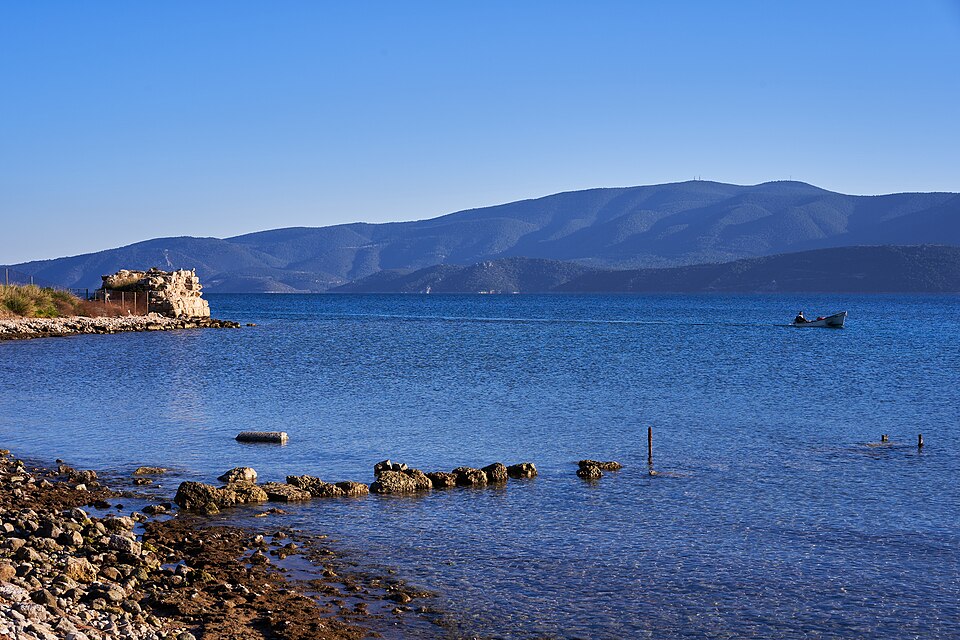
Cenchreae was the eastern harbour of Corinth, on the Saronic Gulf where the village of Kechries stands today. Strabo puts it about seventy stadia from the city and says it served the trade from Asia, while Lechaeum, Corinth's harbour on the other sea, served the trade from Italy. Pausanias tells that the harbours were named after Leches and Cenchrias, said to be children of Poseidon.
In the Peloponnesian War Corinth kept troops and ships here. In 425 BC, when the Athenians landed on Corinthian territory, the Corinthians left half their force at Cenchreae, and in 412 BC the Peloponnesian ships for the war in Ionia sailed from it. After Corinth was refounded as a Roman colony in 44 BC, the port flourished. Pausanias, in the second century AD, saw a temple of Aphrodite, a bronze Poseidon on the mole and, at the other end of the harbour, sanctuaries of Asclepius and of Isis. Apuleius, in his novel the Metamorphoses, sets at Cenchreae the spring festival of Isis, when her priests dedicate a newly built ship at the opening of the sailing season.
When Paul left Corinth after his long stay, he sailed for Syria with Priscilla and Aquila, "having shorn his head in Cenchrea: for he had a vow". In his letter to the Romans, probably written from Corinth, he commends to them Phebe, "a servant of the church which is at Cenchrea", and asks them to receive her and help her; she had been a helper of many, and of Paul himself.
American excavations of the 1960s under Robert Scranton uncovered warehouses, fish tanks and, in the now submerged southern part of the harbour, a complex that the excavators took to be the sanctuary of Isis named by Pausanias. In it lay crates of panels of coloured glass, still packed, which sank when an earthquake struck in the later fourth century AD. A Christian basilica was later built at the southern end of the harbour, and the port remained in use into the seventh century.
Scripture: Acts 18:18; Rom 16:1–2
Sources
- Thucydides, History 4.42.4; 8.10.1; 8.20.1; 8.23.1, 5
- Strabo, Geography 8.6.22
- Pausanias, Description of Greece 2.2.3
- Apuleius, Metamorphoses 10.35; 11.5; 11.16
- R. Scranton, J. W. Shaw and L. Ibrahim, Kenchreai, Eastern Port of Corinth I: Topography and Architecture (1978)
- L. Ibrahim, R. Scranton and R. Brill, Kenchreai, Eastern Port of Corinth II: The Panels of Opus Sectile in Glass (1976)
- J. Murphy-O'Connor, St. Paul's Corinth: Texts and Archaeology (3rd ed., 2002)
Checked against its sources; not yet read by a historian.
Verses (2)
- Acts 18:18
- And Paul after this tarried there yet a good while, and then took his leave of the brethren, and sailed thence into Syria, and with him Priscilla and Aquila; having shorn his head in Cenchrea: for he had a vow.
- Rom 16:1
- I commend unto you Phebe our sister, which is a servant of the church which is at Cenchrea:
King James Version