 History Globe
town or village
Gerar
- Today Tel Haror
- Most likely location
History
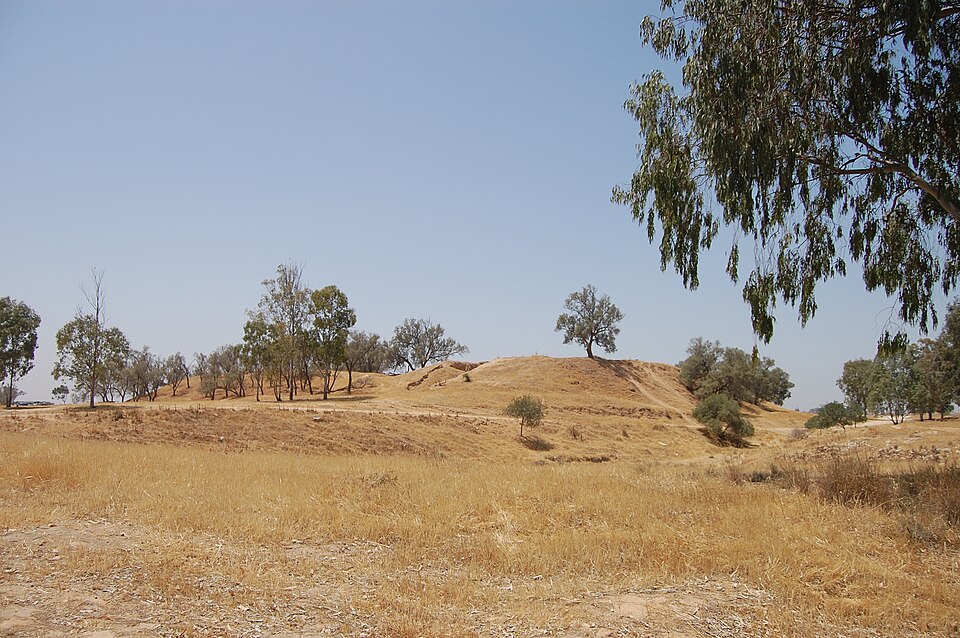
Gerar was a town of the western Negev, between Gaza and Beersheba. It is now usually identified with Tel Haror (Tell Abu Hureira), a large mound on the north bank of Nahal Gerar, a little over 20 km north-west of Beersheba. Yohanan Aharoni proposed the site in 1956; earlier scholars had looked to Tell Jemmeh or to Tell esh-Sharia nearby. Eliezer Oren of Ben-Gurion University excavated Tel Haror in the 1980s and early 1990s.
In the Middle Bronze Age, in the seventeenth and sixteenth centuries BC, Tel Haror was one of the largest cities of southern Canaan, about 16 ha (40 acres), fortified with massive earthen ramparts and a deep moat. In its sacred precinct stood a temple of Syrian type, and around it were many pits of offerings, among them puppies and birds; a young donkey was buried there with a metal bit in its mouth and saddlebag fittings on its back. In the Iron Age Philistine pottery appears, and in the later Iron Age a strongly fortified town with a thick wall, glacis and towers stood on the upper mound until it was destroyed by fire.
In Genesis the border of the Canaanites ran "from Sidon, as thou comest to Gerar, unto Gaza". Abraham sojourned in Gerar; Abimelech, king of Gerar, took Sarah, whom Abraham had called his sister, but God warned him in a dream and he restored her. In a famine Isaac went "unto Abimelech king of the Philistines unto Gerar", said the same of Rebekah, and later dug wells in the valley of Gerar; the herdmen of Gerar strove with his herdmen over the wells Esek and Sitnah, but not over Rehoboth. Many scholars regard the Philistines of these stories as an anachronism. Much later Asa, king of Judah, pursued the army of Zerah the Ethiopian as far as Gerar and plundered all the cities round about it.
The name outlived the town and passed to the district around it. In the early fourth century AD Eusebius places Gerara twenty-five miles south of Eleutheropolis, calls it a royal city of the Philistines and the old southern boundary of the Canaanites, and says that the Geraritike, the region beyond the Daroma, is named after it. Sozomen, writing in the fifth century, tells that the monk Silvanus, who had lived in Egypt and at Mount Sinai, founded at Gerara, in the wadi, a very large and famous monastery.
Scripture: Gen 10:19; Gen 20:1–3; Gen 20:14; Gen 26:1; Gen 26:6–7; Gen 26:17–22; 2 Chr 14:9–14
Sources
- Eusebius, Onomasticon, s.v. Gerara (C. U. Wolf's translation, no. 294)
- Sozomen, Ecclesiastical History 6.32 (Silvanus' monastery at Gerara)
- G. Bar-Oz, P. Nahshoni, H. Motro and E. D. Oren, 'Symbolic Metal Bit and Saddlebag Fastenings in a Middle Bronze Age Donkey Burial', PLoS ONE 8.3 (2013), e58648
- E. D. Oren, 'Tel Haror', in E. Stern (ed.), The New Encyclopedia of Archaeological Excavations in the Holy Land (1993), pp. 580-584
- E. D. Oren, 'Gerar (Place)', in D. N. Freedman (ed.), The Anchor Bible Dictionary 2 (1992), pp. 989-991
- Y. M. Grintz, 'Gerar', Encyclopaedia Judaica (2nd ed., 2007) (Aharoni's identification; the earlier candidates)
Checked against its sources; not yet read by a historian.
Verses (9)
- Gen 10:19
- And the border of the Canaanites was from Sidon, as thou comest to Gerar, unto Gaza; as thou goest, unto Sodom, and Gomorrah, and Admah, and Zeboim, even unto Lasha.
- Gen 20:1
- And Abraham journeyed from thence toward the south country, and dwelled between Kadesh and Shur, and sojourned in Gerar.
- Gen 20:2
- And Abraham said of Sarah his wife, She is my sister: and Abimelech king of Gerar sent, and took Sarah.
- Gen 26:1
- And there was a famine in the land, beside the first famine that was in the days of Abraham. And Isaac went unto Abimelech king of the Philistines unto Gerar.
- Gen 26:6
- And Isaac dwelt in Gerar:
- Gen 26:20
- And the herdmen of Gerar did strive with Isaac’s herdmen, saying, The water is ours: and he called the name of the well Esek; because they strove with him.
- Gen 26:26
- Then Abimelech went to him from Gerar, and Ahuzzath one of his friends, and Phichol the chief captain of his army.
- 2 Chr 14:13
- And Asa and the people that were with him pursued them unto Gerar: and the Ethiopians were overthrown, that they could not recover themselves; for they were destroyed before the LORD, and before his host; and they carried away very much spoil.
- 2 Chr 14:14
- And they smote all the cities round about Gerar; for the fear of the LORD came upon them: and they spoiled all the cities; for there was exceeding much spoil in them.
King James Version