 History Globe
town or village
Heliopolis
- Today Ain Shams
History
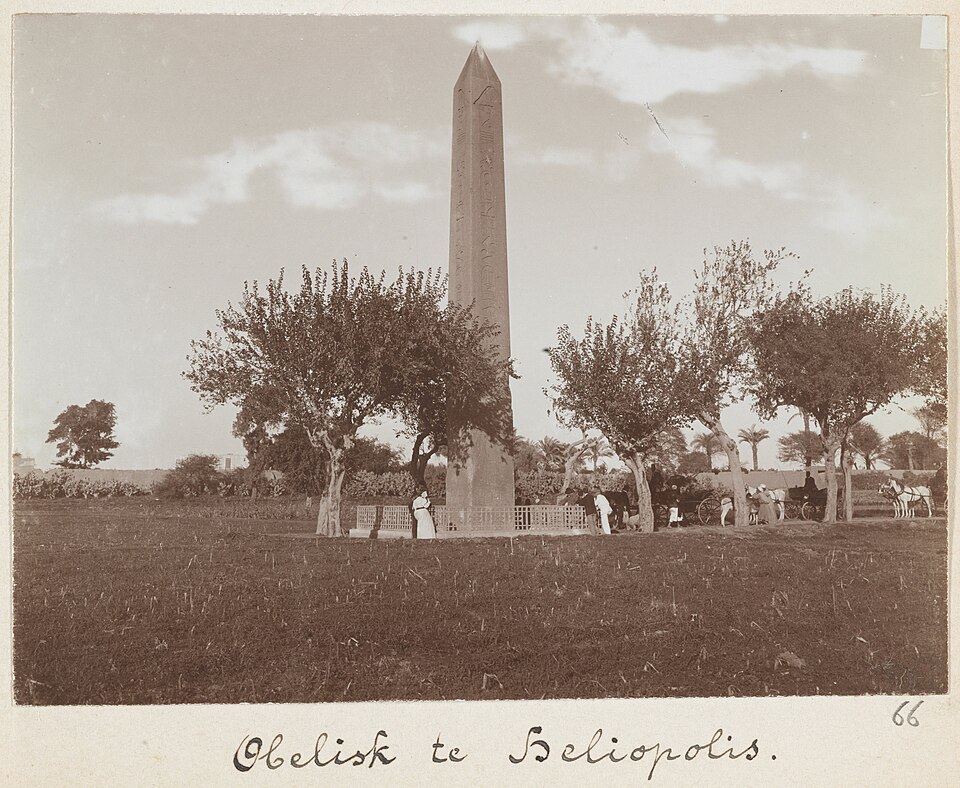
Heliopolis, the On of the Bible, lay at the south-eastern edge of the Nile delta, where the Cairo districts of Matariya and Ain Shams are today. The Egyptians called it Iunu, and the Greeks the City of the Sun. It was the chief seat of the sun god Ra and of Atum, and its priests taught of the nine gods, the Ennead, at whose head stood the creator. Of its great temple little remains above ground, but the obelisk that Senusret I set up there in the twentieth century BC still stands where it was raised.
Pharaoh gave Joseph to wife Asenath, the daughter of Poti-pherah priest of On, and she bore him Manasseh and Ephraim. The Greek Septuagint adds On, that is Heliopolis, to Pithom and Raamses among the cities built by the Israelites in Egypt, and the Russian Synodal text keeps this addition. Jeremiah foretold that Nebuchadrezzar would break the images of Beth-shemesh, the house of the sun, that is in the land of Egypt, a name usually taken to mean Heliopolis; Ezekiel calls the city Aven and says that its young men shall fall by the sword.
Herodotus went to Heliopolis to question its priests, for its people were said to be the most learned of the Egyptians in records, and he heard there the tale of the phoenix. Strabo found the city on its mound entirely deserted, though the temple of the sun and the sacred bull Mnevis were still kept; he was shown the large houses of the priests, where Plato and Eudoxus were said to have stayed. Augustus carried two of its obelisks to Rome and set them up in the Circus Maximus and the Campus Martius.
In the mid-second century BC Onias, of the high-priestly family, who had fled to Egypt, built a Jewish temple with leave from Ptolemy VI at Leontopolis in the district of Heliopolis, appealing to Isaiah's word of an altar to the Lord in the midst of the land of Egypt. After the Jewish War Vespasian had it shut, about AD 73. In the Middle Ages the ruins of Heliopolis were quarried for the building of Cairo.
Scripture: Gen 41:45; Gen 41:50; Gen 46:20; Exod 1:11; Jer 43:13; Ezek 30:17; Isa 19:19
Sources
- Septuagint, Exodus 1:11 (On, which is Heliopolis)
- Herodotus, Histories 2.3 (the learned men of Heliopolis); 2.73 (the phoenix)
- Strabo, Geography 17.1.27-29
- Ammianus Marcellinus 17.4.12 (Augustus' two obelisks from Heliopolis)
- Josephus, Antiquities 13.62-73; Jewish War 7.420-436 (the temple of Onias in the district of Heliopolis)
- S. Quirke, The Cult of Ra: Sun-Worship in Ancient Egypt (2001)
- I. Shaw (ed.), The Oxford History of Ancient Egypt (2000)
Checked against its sources; not yet read by a historian.
Verses (5)
- Gen 41:45
- And Pharaoh called Joseph’s name Zaphnath-paaneah; and he gave him to wife Asenath the daughter of Poti-pherah priest of On. And Joseph went out over all the land of Egypt.
- Gen 41:50
- And unto Joseph were born two sons before the years of famine came, which Asenath the daughter of Poti-pherah priest of On bare unto him.
- Gen 46:20
- And unto Joseph in the land of Egypt were born Manasseh and Ephraim, which Asenath the daughter of Poti-pherah priest of On bare unto him.
- Jer 43:13
- He shall break also the images of Beth-shemesh, that is in the land of Egypt; and the houses of the gods of the Egyptians shall he burn with fire.
- Ezek 30:17
- The young men of Aven and of Pi-beseth shall fall by the sword: and these cities shall go into captivity.
King James Version