 History Globe
town or village
Michmash
- Today Mukhmas
- Location disputed
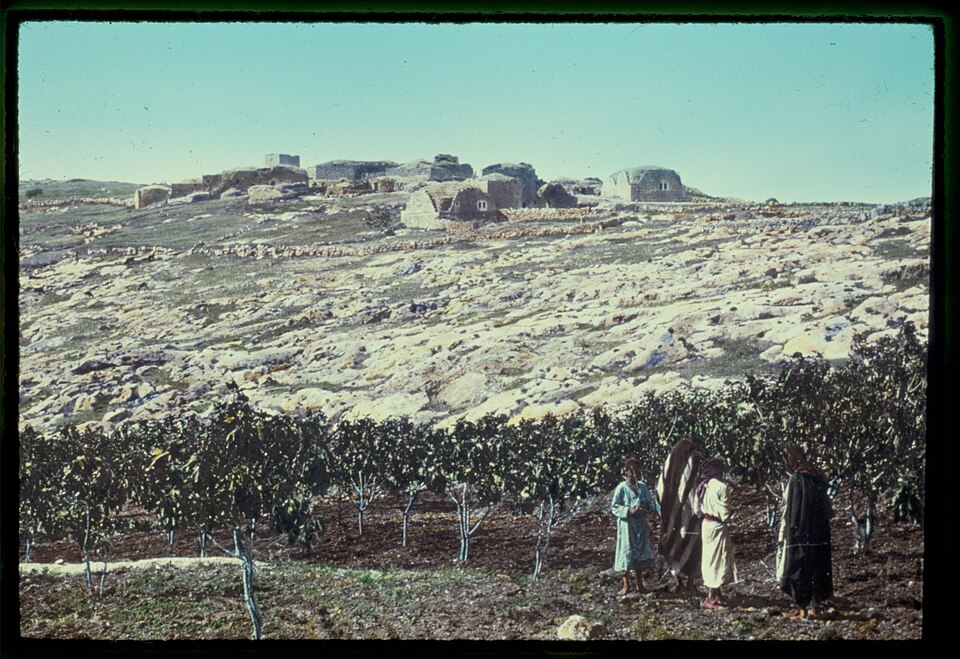
Photo: Matson Collection, public domain, Wikimedia Commons
Battles and sieges
- c. 1050 BCJonathan's exploit at Michmash 1 Sam 14:1–23
Jonathan and his armourbearer, then Saul's six hundred, against the Philistine garrison at Michmash. Panic and an earthquake in the Philistine camp; they fall on each other, and the battle passes over to Beth-aven.
History
Michmash was a town of Benjamin about 11 km north-north-east of Jerusalem. It is identified with the village of Mukhmas, which keeps the ancient name. The town stood on the north side of the steep gorge of Wadi es-Suweinit; Geba, today's Jaba, faces it on the south side, little more than 2 km away. Here the way from the north to Jerusalem crossed the gorge, at the place the Bible calls the passage of Michmash.
Michmash is best known from Saul's war with the Philistines. Saul first held Michmash with two thousand men, while Jonathan was in Gibeah. After Jonathan struck the Philistine garrison in Geba, the Philistines came up in great numbers and camped at Michmash, and their garrison went out to the passage of Michmash. Between the two sides stood two sharp rocks, Bozez and Seneh; Jonathan and his armourbearer climbed up to the Philistine post, the camp fell into panic, and that day Israel struck the Philistines from Michmash to Aijalon.
Isaiah names Michmash in his picture of an army marching on Jerusalem from the north: "at Michmash he hath laid up his carriages". After the exile 122 men of Michmash returned from Babylon, and in Nehemiah's day it was one of the places where the Benjamites lived.
When Bacchides, the Seleucid general, made peace with Jonathan Maccabeus and left Judea in the 150s BC, Jonathan settled at Michmash and began to govern the people from there; both 1 Maccabees and Josephus record this. In the fourth century Eusebius mentions a large village called Machmas in the district of Jerusalem, nine miles from the city, near Rama.
Scripture: 1 Sam 13:2; 1 Sam 13:3–5; 1 Sam 13:16; 1 Sam 13:23; 1 Sam 14:1–16; 1 Sam 14:31; Isa 10:28; Ezra 2:27; Neh 7:31; Neh 11:31
Sources
- 1 Maccabees 9.70-73
- Josephus, Antiquities 13.33-34
- Eusebius, Onomasticon, s.v. Machmas (Wolf no. 697)
- J. M. Miller, 'Geba/Gibeah of Benjamin', Vetus Testamentum 25 (1975) 145-166
- Y. Aharoni, The Land of the Bible: A Historical Geography (2nd ed., 1979)
Checked against its sources; not yet read by a historian.
Verses (11)
- 1 Sam 13:2
- Saul chose him three thousand men of Israel; whereof two thousand were with Saul in Michmash and in mount Beth-el, and a thousand were with Jonathan in Gibeah of Benjamin: and the rest of the people he sent every man to his tent.
- 1 Sam 13:5
- And the Philistines gathered themselves together to fight with Israel, thirty thousand chariots, and six thousand horsemen, and people as the sand which is on the sea shore in multitude: and they came up, and pitched in Michmash, eastward from Beth-aven.
- 1 Sam 13:11
- And Samuel said, What hast thou done? And Saul said, Because I saw that the people were scattered from me, and that thou camest not within the days appointed, and that the Philistines gathered themselves together at Michmash;
- 1 Sam 13:16
- And Saul, and Jonathan his son, and the people that were present with them, abode in Gibeah of Benjamin: but the Philistines encamped in Michmash.
- 1 Sam 13:23
- And the garrison of the Philistines went out to the passage of Michmash.
- 1 Sam 14:5
- The forefront of the one was situate northward over against Michmash, and the other southward over against Gibeah.
- 1 Sam 14:31
- And they smote the Philistines that day from Michmash to Aijalon: and the people were very faint.
- Ezra 2:27
- The men of Michmas, an hundred twenty and two.
- Neh 7:31
- The men of Michmas, an hundred and twenty and two.
- Neh 11:31
- The children also of Benjamin from Geba dwelt at Michmash, and Aija, and Beth-el, and in their villages,
- Isa 10:28
- He is come to Aiath, he is passed to Migron; at Michmash he hath laid up his carriages:
King James Version