 History Globe
town or village
Myra
History
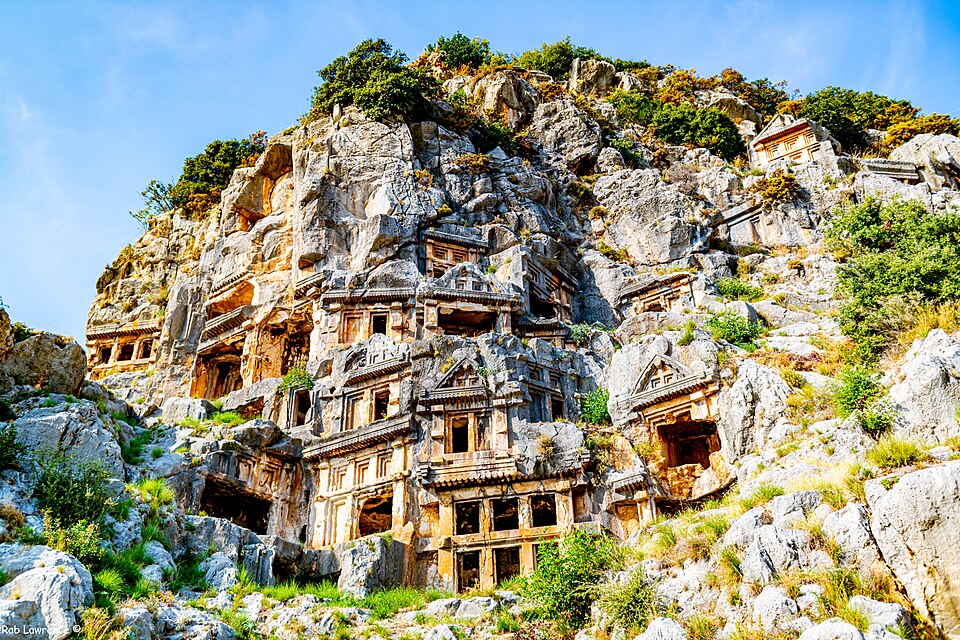
Myra lay in Lycia, on the south coast of Asia Minor, beside modern Demre in Turkey. It stood on the river Myros a little inland, and its harbour was Andriake at the river's mouth; Strabo places the city twenty stadia above the sea on a lofty hill. In the cliffs above the town the Lycians carved tombs shaped like houses and temple fronts, many of them in the fourth century BC. Silt from the river has since buried much of the lower city.
Myra was one of the six largest cities of the Lycian League, which, Strabo says, cast three votes each in its common council. Under Rome the league kept its own government until Claudius took away the Lycians' freedom because of their feuds and made Lycia a province. Under Hadrian a large granary was built at Andriake.
Paul, sent to Rome as a prisoner in the charge of a centurion named Julius, sailed along the coast of Asia, crossed the sea of Cilicia and Pamphylia and came to Myra. There the centurion found a ship of Alexandria sailing into Italy and put the prisoners on board. It was this ship, carrying wheat, that was later wrecked on Malta.
In the reign of Antoninus Pius a violent earthquake overthrew the cities of Lycia, and the emperor paid for their rebuilding; the large theatre at Myra was restored after it. In the fourth century Nicholas was bishop of Myra; little is known of his life for certain, and his presence at the Council of Nicaea in 325 is first reported in later lists. In late antiquity Myra was the chief city of the province of Lycia and the seat of its metropolitan bishop.
Scripture: Acts 27:1–2; Acts 27:5–6; Acts 27:38; Acts 27:41–44; Acts 28:1
Sources
- Strabo, Geography 14.3.3 (the six largest cities of the Lycian League, three votes each); 14.3.7 (Myra twenty stadia above the sea)
- Suetonius, Claudius 25.3 (the Lycians deprived of their freedom)
- Pausanias, Description of Greece 8.43.4 (the earthquake in Lycia under Antoninus Pius)
- G. E. Bean, Lycian Turkey: An Archaeological Guide (1978)
- T. R. Bryce, The Lycians in Literary and Epigraphic Sources (1986)
Checked against its sources; not yet read by a historian.
Verses (1)
- Acts 27:5
- And when we had sailed over the sea of Cilicia and Pamphylia, we came to Myra, a city of Lycia.
King James Version