 History Globe
town or village
Puteoli
- Today Pozzuoli
Lifetime: c. 531 BC – …
Founded as Dicaearchia, a harbour of Cumae settled by exiles from Samos (Eusebius dates them a few years later, 521 BC); it became the Roman colony of Puteoli in 194 BC.
History
Puteoli, today's Pozzuoli, lies on the Bay of Naples in Campania, in the volcanic country of hot springs and sulphur west of Naples. It began as the Greek town of Dicaearchia: Strabo calls it the port of Cumae, while Eusebius and Stephanus of Byzantium say settlers from Samos founded it in the later sixth century BC. Strabo derives the Latin name Puteoli from its wells, or from the smell of its waters. In 215 BC the Romans fortified and garrisoned it against Hannibal, and in 194 BC they settled a colony of Roman citizens there.
Its harbour, built with the local volcanic sand that sets hard even under water, made Puteoli the chief port of Rome in the late Republic and early Empire. Grain ships from Alexandria unloaded here, and Seneca describes the crowds on the mole watching for the first of them. Merchants from the East settled in the town, among them Jews: Josephus tells how the impostor who passed himself off as Herod's son Alexander was received by the Jews of Dicaearchia. Caligula bridged the bay from Baiae to the mole of Puteoli with a double line of ships.
Paul, a prisoner bound for Rome, came here from Rhegium in an Alexandrian ship: "we came the next day to Puteoli: Where we found brethren, and were desired to tarry with them seven days". From there he went on by road toward Rome, and brethren came out to meet him as far as Appii Forum and the Three Taverns. A few years later Josephus, after a shipwreck in the Adriatic Sea, also landed at Puteoli; there he met a Jewish actor favoured by Nero, through whom he reached the empress Poppaea.
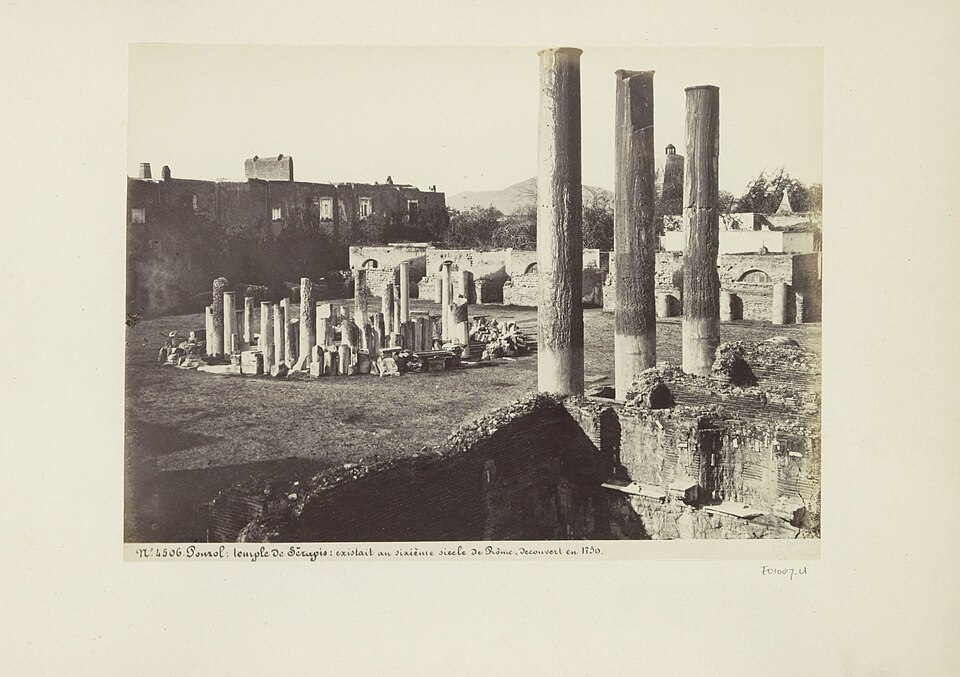
In AD 60 Nero gave the old town the rights and title of a colony. Under the Flavian emperors it built a great amphitheatre, and the ruins of its market hall, long misnamed the Temple of Serapis, still stand. Hadrian, who died at nearby Baiae in 138, was first buried at Puteoli on an estate that had once belonged to Cicero. After Claudius built a harbour at Ostia, later enlarged by Trajan, much of the trade of Rome moved there, and Puteoli slowly lost its place, though it remained a town of some note into late antiquity.
Scripture: Acts 28:11–13; Acts 28:14–15
Sources
- Strabo, Geography 5.4.6
- Jerome, Chronicle, 531 BC (the Samians found Dicaearchia, now Puteoli)
- Stephanus of Byzantium, Ethnica, s.v. Potioloi
- Livy 24.7.10 (fortified in 215 BC); 34.45.1 (the colony of 194 BC)
- Seneca, Moral Letters 77.1-2
- Josephus, Antiquities 17.328; Jewish War 2.104; Life 15-16
- Suetonius, Caligula 19; Claudius 20
- Tacitus, Annals 14.27
- Historia Augusta, Hadrian 25.7
- J. H. D'Arms, Romans on the Bay of Naples (1970)
- R. Meiggs, Roman Ostia (2nd ed., 1973)
Checked against its sources; not yet read by a historian.
Verses (1)
- Acts 28:13
- And from thence we fetched a compass, and came to Rhegium: and after one day the south wind blew, and we came the next day to Puteoli:
King James Version