 History Globe
region
Ur
- Today Tell el Muqayyar
- Most likely location
Events
- c. 2600 BCThe Royal Cemetery of Ur: Puabi and other rulers are buried with their retinues
- c. 2112 BCUr-Nammu founds the Third Dynasty of Ur
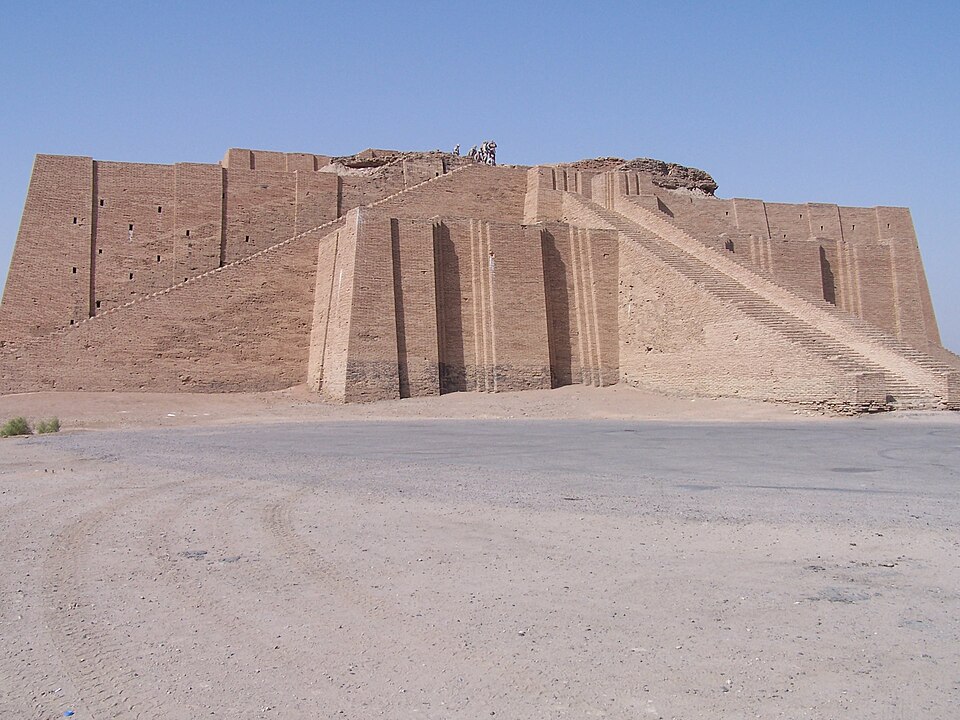
- c. 2100 BCUr-Nammu builds the ziggurat of Ur
- c. 2004 BCElamites take Ur: the end of the Third Dynasty
In ancient writers
- Eusebius (quoting Eupolemus), Preparation for the Gospel 9.17 — Quoting Alexander Polyhistor, Eusebius cites Eupolemus: Abraham was born in Camarina, a city of Babylonia which some call Uria, meaning the city of the Chaldees, and he excelled all men in nobility and wisdom.
Questions
History
Ur lay in the far south of Mesopotamia, at the mound of Tell el-Muqayyar, 16 km south-west of modern Nasiriyah. In antiquity it stood on the Euphrates near the head of the Gulf; the river and the coast have since moved away. It was settled already in the Ubaid period, the prehistoric age of southern Mesopotamia, and became one of the great Sumerian cities, sacred to the moon god Nanna. Leonard Woolley's excavations of 1922–1934 uncovered the Royal Cemetery of the mid-third millennium BC, with its gold, lyres and the so-called Standard of Ur.
Its height was the Third Dynasty of Ur (c. 2112–2004 BC in the middle chronology). Ur-Nammu and his son Shulgi ruled Sumer and Akkad from here, and Ur-Nammu built the ziggurat whose lower stages still stand. About 2004 BC the Elamites took the city and carried off its last king, Ibbi-Sin, a disaster mourned in the Lament for Sumer and Ur. Ur recovered and lived on as a temple city under later Babylonian kings.
Genesis says that Terah set out with Abram from Ur of the Chaldees to go to Canaan and settled at Haran; Nehemiah and Stephen's speech in Acts recall the departure. Most scholars identify this Ur with Tell el-Muqayyar, but the identification is debated: an old tradition points to Urfa in northern Mesopotamia, and some scholars have argued for an Ur in the north, nearer Haran.
In the sixth century BC Nebuchadnezzar and Nabonidus rebuilt Ur's temples. Nabonidus restored the ziggurat and made his daughter high priestess of the moon god, and his inscribed cylinders from the ziggurat name his son Belshazzar. After the Persian conquest the city declined, perhaps as the Euphrates shifted its course, and it was abandoned in the Persian period, long before the end of antiquity.
Scripture: Gen 11:28; Gen 11:31; Gen 15:7; Neh 9:7; Acts 7:2–4
Sources
- Sumerian King List; Lament for Sumer and Ur
- Nabonidus Cylinders from the ziggurat of Ur
- C. L. Woolley, Ur Excavations II: The Royal Cemetery (1934)
- C. L. Woolley and P. R. S. Moorey, Ur 'of the Chaldees' (1982)
- C. H. Gordon, 'Abraham and the Merchants of Ura', Journal of Near Eastern Studies 17 (1958)
- M. Van De Mieroop, A History of the Ancient Near East (3rd ed., 2016), ch. 5 (middle chronology)
Checked against its sources; not yet read by a historian.
Verses (4)
- Gen 11:28
- And Haran died before his father Terah in the land of his nativity, in Ur of the Chaldees.
- Gen 11:31
- And Terah took Abram his son, and Lot the son of Haran his son’s son, and Sarai his daughter in law, his son Abram’s wife; and they went forth with them from Ur of the Chaldees, to go into the land of Canaan; and they came unto Haran, and dwelt there.
- Gen 15:7
- And he said unto him, I am the LORD that brought thee out of Ur of the Chaldees, to give thee this land to inherit it.
- Neh 9:7
- Thou art the LORD the God, who didst choose Abram, and broughtest him forth out of Ur of the Chaldees, and gavest him the name of Abraham;
King James Version