 History Globe
town or village
Athens
Events
- 480 BCXerxes takes Athens and burns the Acropolis
- AD 529Justinian forbids the teaching of philosophy at Athens
In ancient writers
- Pausanias, Description of Greece 1.1.4 — At Phalerum, the old harbour of Athens, stand a sanctuary of Demeter, a temple of Athena Sciras, one of Zeus, and altars of the gods named Unknown, of heroes, and of the children of Theseus.
- Pausanias, Description of Greece 1.17.1 — In the Athenian marketplace is an altar to Mercy, honoured by the Athenians alone among the Greeks; they are conspicuous for their humanity and devotion to religion, with altars even to Shamefastness, Rumour and Effort.
- Pausanias, Description of Greece 1.24.5 — Entering the Parthenon, the front pediment shows the birth of Athena and the rear the contest of Athena and Poseidon for the land; the statue of the goddess itself is of ivory and gold.
History
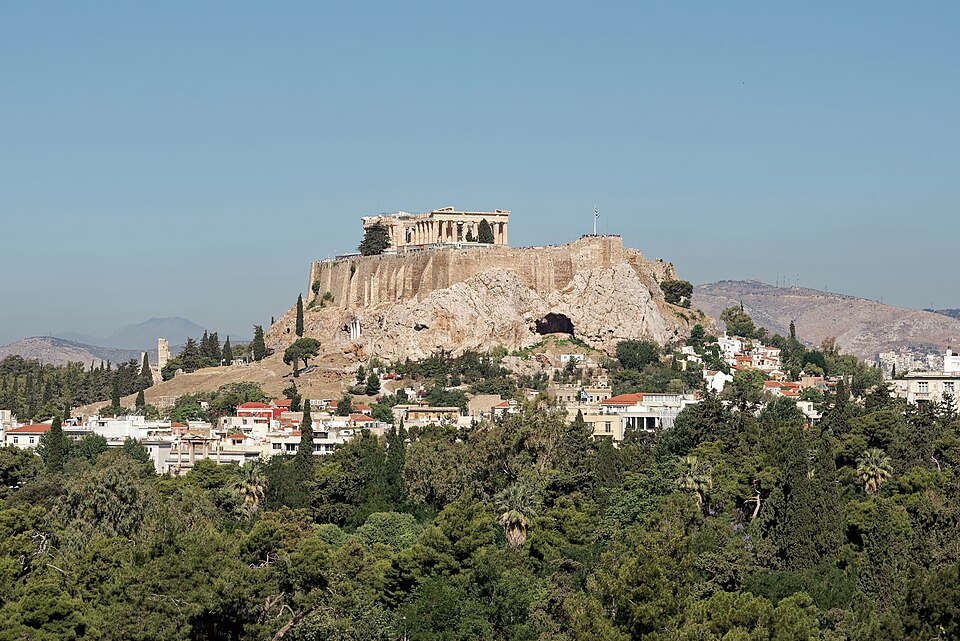
Athens lies in the plain of Attica around the rock of the Acropolis, about 8 km from its harbour at Piraeus. The Acropolis was lived on from the Neolithic, and in the thirteenth century BC it was a Mycenaean stronghold. Solon reformed the laws in 594 BC, and the reforms of Cleisthenes in 508–507 BC laid the foundation of the Athenian democracy.
Athens helped defeat Persia at Marathon in 490 BC; ten years later the Persians burned the Acropolis, and the Greek fleet won at Salamis. Under Pericles the Parthenon was built between 447 and 432 BC. Athens lost the Peloponnesian War to Sparta in 404 BC, and in 399 BC it put Socrates to death. Plato's Academy, Aristotle's Lyceum and the schools of the Stoics and Epicureans made it the home of philosophy. Sulla stormed the city in 86 BC, yet under Rome it remained a centre of learning, and Hadrian completed the temple of Olympian Zeus.
Paul came to Athens from Beroea and waited there for Silas and Timothy. Stirred by the city full of idols, he argued in the synagogue and daily in the agora. Epicurean and Stoic philosophers brought him to the Areopagus, where he spoke of an altar to an unknown god. A few believed, among them Dionysius the Areopagite and a woman named Damaris; a later bishop of Corinth names Dionysius the first bishop of Athens. Eusebius writes that Quadratus and Aristides, whom Jerome calls an Athenian philosopher, addressed defences of the Christian faith to Hadrian.
In AD 267 the Heruli sacked the city, and a smaller wall was then built around its centre. In the fourth century Basil the Great and Gregory of Nazianzus studied there, as did the future emperor Julian. Alaric's Goths overran Greece in 395–396; what befell Athens is told differently by ancient writers. Through the fifth century a Neoplatonist school still taught there, led by Proclus until his death in 485.
Scripture: Acts 17:15–34; 1 Thess 3:1
Sources
- Aristotle, Constitution of the Athenians 5-12; 20-22
- Herodotus, Histories 6.102-117; 8.53; 8.83-96
- Plutarch, Pericles 12-13; Plutarch, Sulla 12-14
- Thucydides, History 5.26; Xenophon, Hellenica 2.2.20-23; Plato, Apology
- Pausanias, Description of Greece 1.18.6-9
- Eusebius, Church History 3.4.10-11; 4.3; 4.23.3; Jerome, On Illustrious Men 20
- Historia Augusta, Gallienus 13.8; Zosimus, New History 5.5-6; Eunapius, Lives of the Sophists
- Gregory of Nazianzus, Oration 43.14-24; Ammianus Marcellinus 15.2.8 (Julian); Marinus, Life of Proclus
- J. M. Camp, The Archaeology of Athens (2001)
- A. Frantz, The Athenian Agora XXIV: Late Antiquity, A.D. 267-700 (1988)
Checked against its sources; not yet read by a historian.
Verses (6)
- Acts 17:15
- And they that conducted Paul brought him unto Athens: and receiving a commandment unto Silas and Timotheus for to come to him with all speed, they departed.
- Acts 17:16
- Now while Paul waited for them at Athens, his spirit was stirred in him, when he saw the city wholly given to idolatry.
- Acts 17:21
- (For all the Athenians and strangers which were there spent their time in nothing else, but either to tell, or to hear some new thing.)
- Acts 17:22
- Then Paul stood in the midst of Mars’ hill, and said, Ye men of Athens, I perceive that in all things ye are too superstitious.
- Acts 18:1
- After these things Paul departed from Athens, and came to Corinth;
- 1 Thess 3:1
- Wherefore when we could no longer forbear, we thought it good to be left at Athens alone;
King James Version