 History Globe
town or village
Bethsaida
- Today At Tell
- Location disputed
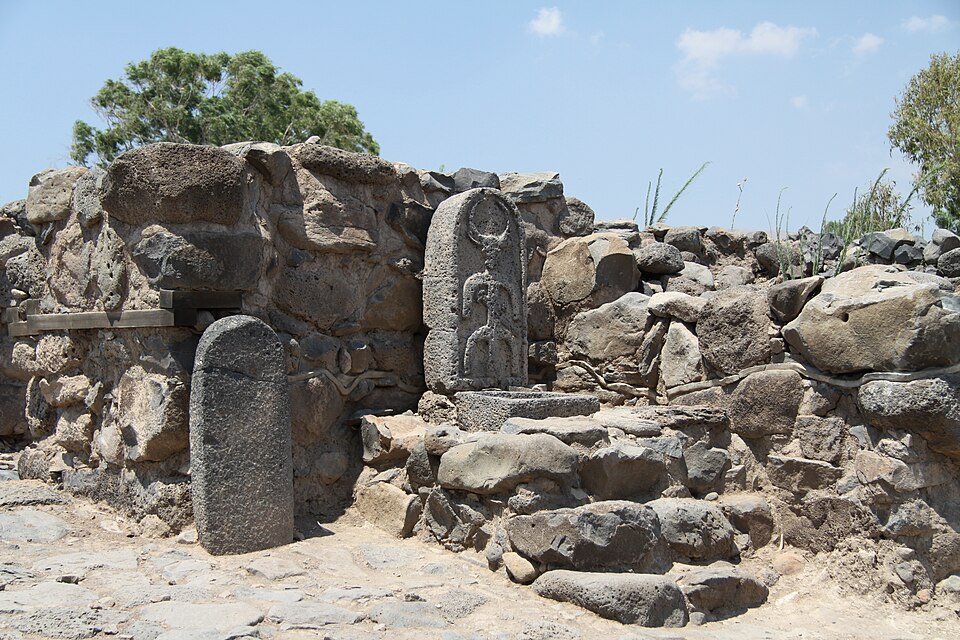
Photo: Chmee2, CC BY 3.0, Wikimedia Commons
Questions
History
Bethsaida, whose name means "house of fishing", lay at the north end of the Sea of Galilee, near where the Jordan enters the lake, east of the river. Its exact site is disputed. One candidate is et-Tell, a mound about 2 km from today's shore, excavated since 1987 under Rami Arav. The other is el-Araj, on the shore by the river mouth, excavated in recent years by Mordechai Aviam and R. Steven Notley. A third site, el-Mesadiyeh, is seldom favoured.
At et-Tell lies a fortified city of the Iron Age with a massive gate, which the excavators take for a capital of the kingdom of Geshur; the view is widely held but remains a hypothesis, since no inscription names the city. In the Bible Talmai, king of Geshur, was the grandfather of Absalom, who fled to him and stayed there three years. The city was destroyed in the late eighth century BC, probably in the Assyrian campaign of Tiglath-pileser III about 732 BC. Josephus says that Philip the tetrarch raised the village of Bethsaida to the rank of a city and named it Julias, after the emperor's daughter; many scholars think rather of Livia, wife of Augustus, who bore the name Julia. Philip died at Julias about AD 34 and was buried in the tomb he had built for himself.
In the Gospels Bethsaida is the town of the apostles Philip, Andrew and Peter. Near it Jesus withdrew with the apostles to a desert place, where the crowds followed and were fed; once he sent the disciples ahead across the lake to Bethsaida. There he led a blind man out of the town and healed him in two stages. With Chorazin, Bethsaida was reproached for not repenting after the mighty works done in it.
In the revolt against Rome Josephus fought the troops of King Agrippa II beside the Jordan near Julias. Pliny the Elder places Julias on the eastern shore of the lake, and in the early fourth century Eusebius knew Bethsaida as the city of Andrew, Peter and Philip by the Lake of Gennesaret. At el-Araj the excavators have found remains of the Roman period, which they take for Julias, and a sixth-century basilica whose Greek inscriptions invoke Saint Peter; they see in it the church that Byzantine tradition built over the apostles' home.
Scripture: John 1:44; John 12:21; 2 Sam 3:3; 2 Sam 13:37–38; Luke 9:10–17; Mark 6:45; Mark 8:22–26; Matt 11:20–21; Luke 10:13
Sources
- Josephus, Antiquities 18.28 (Bethsaida made a city and named Julias); 18.106-108 (Philip's death and burial at Julias); Jewish War 2.168; 3.515
- Josephus, Life 398-406 (the fighting near Julias)
- Pliny the Elder, Natural History 5.71
- Eusebius, Onomasticon, s.v. Bethsaida (C. U. Wolf's translation, no. 287)
- R. Arav and R. A. Freund (eds.), Bethsaida: A City by the North Shore of the Sea of Galilee, vol. 1 (1995)
- R. S. Notley, 'Et-Tell Is Not Bethsaida', Near Eastern Archaeology 70 (2007) 220-230; R. Arav, 'Bethsaida: A Response to Steven Notley', Near Eastern Archaeology 74 (2011) 92-100
- R. S. Notley, 'Byzantine Bethsaida and the House of St. Peter', Novum Testamentum 64 (2022) 532-551
- L. Di Segni, J. Ashkenazi, M. Aviam and R. S. Notley, 'The Greek Inscriptions from the Church of St. Peter at Bethsaida (el-Araj)', Liber Annuus 73 (2023) 365-384
Checked against its sources; not yet read by a historian.
Verses (4)
- Matt 11:21
- Woe unto thee, Chorazin! woe unto thee, Bethsaida! for if the mighty works, which were done in you, had been done in Tyre and Sidon, they would have repented long ago in sackcloth and ashes.
- Luke 10:13
- Woe unto thee, Chorazin! woe unto thee, Bethsaida! for if the mighty works had been done in Tyre and Sidon, which have been done in you, they had a great while ago repented, sitting in sackcloth and ashes.
- John 1:44
- Now Philip was of Bethsaida, the city of Andrew and Peter.
- John 12:21
- The same came therefore to Philip, which was of Bethsaida of Galilee, and desired him, saying, Sir, we would see Jesus.
King James Version