 History Globe
town or village
Caesarea
- Today Caesarea Maritima
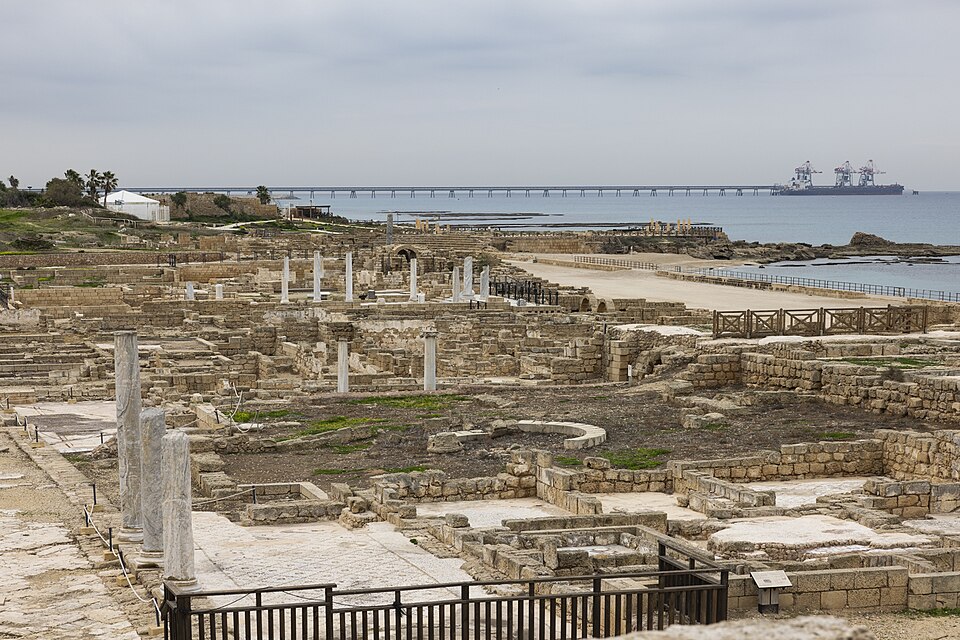
Lifetime: 22 BC – AD 1265
Built by Herod the Great from 22 BC on the site of Strato's Tower. In 1265 the Mamluk sultan Baybars took the Crusader city and razed it so that the Franks could not use it again; the ruins lay empty for six centuries.
Events
- c. 10 BCHerod dedicates Caesarea and its new harbour
- c. AD 26Pontius Pilate becomes prefect of Judea
- AD 44Herod Agrippa I dies at Caesarea
- c. AD 232Origen leaves Alexandria for Caesarea
- c. AD 640After a long siege the Arabs take Caesarea, the capital of Byzantine Palestine
- AD 1265Baybars takes Caesarea and razes it
In ancient writers
- Josephus, Jewish War 1.408–410 — Herod rebuilt the decayed Strato's Tower in white stone with splendid palaces and, since the whole coast between Dora and Joppa had no haven, overcame nature with a harbour larger than Piraeus.
- Josephus, Jewish Antiquities 15.331–333 — Herod's greatest work at Caesarea was a harbour always free from the waves, as large as Piraeus, built at vast expense from imported materials on a shore exposed to the south wind.
- Tacitus, Histories 2.79 — In AD 69 Mucianus went to Antioch and Vespasian to Caesarea, the capitals of Syria and Judea; the army of Judea swore allegiance to Vespasian in person on 3 July.
History
Caesarea lies on the Mediterranean coast of the Sharon plain, on a stretch of shore with no natural harbour. In the Persian period a small Phoenician anchorage stood here, Strato's Tower, perhaps named after Straton, a king of Sidon; the Zenon papyri mention it in 259 BC. Alexander Jannaeus added it to the Hasmonean kingdom, Pompey made it a free town in 63 BC, and in 30 BC Augustus gave it to Herod the Great.
From 22 BC Herod built a new city on the site and named it Caesarea after the emperor. Its harbour, Sebastos, was made with breakwaters of hydraulic concrete laid in the open sea; above it stood a temple of Roma and Augustus, with a theatre, a palace on a promontory and an aqueduct. The city was dedicated with games in about 10 BC. When Judea became a province in AD 6, Caesarea became the seat of its Roman governors; a stone found in the theatre in 1961 names Pontius Pilate as prefect of Judea.
In Acts, Philip the evangelist settled in Caesarea, and at Peter's word the centurion Cornelius and his household were baptised there, gentiles received into the church. Herod Agrippa I died at Caesarea in AD 44, as both Acts and Josephus relate. Paul passed through the port several times and was held there for two years under the governors Felix and Festus before he spoke before Agrippa II and sailed for Rome.
Strife between the city's Greeks and Jews helped spark the revolt of AD 66. Vespasian made Caesarea a Roman colony, and after 135 it remained the capital of the province, now called Syria Palaestina. Origen settled there in the 230s, and the library gathered by him and Pamphilus served Eusebius, bishop of Caesarea from about 313, who recorded the martyrs who died in the city under Diocletian. Rabbis also taught there. In 333 the Pilgrim of Bordeaux was shown the bath of Cornelius, and about 390 Caesarea became the metropolis of Palaestina Prima.
Scripture: Acts 8:40; Acts 21:8; Acts 10:1–48; Acts 12:19–23; Acts 9:30; Acts 18:22; Acts 23:23–35; Acts 24:27; Acts 25:1–27; Acts 26:32–27:2
Sources
- Zenon papyri, P. Cair. Zen. I 59004 (Strato's Tower, 259 BC); D. W. Roller and R. L. Hohlfelder, 'The Problem of the Location of Straton's Tower', BASOR 252 (1983)
- Josephus, Antiquities 13.324; 13.395; 14.76; 15.217; 15.331-341; 16.136-141; 19.343-350; 20.173-184; Jewish War 1.408-415; 2.266-270; 2.284-292
- The Pilate stone from the theatre at Caesarea (found 1961)
- Pliny the Elder, Natural History 5.69
- Eusebius, Ecclesiastical History 6.26; Martyrs of Palestine
- Pilgrim of Bordeaux, Itinerarium Burdigalense (AD 333), the entry on Caesarea
- K. G. Holum, R. L. Hohlfelder, R. J. Bull and A. Raban, King Herod's Dream: Caesarea on the Sea (1988)
- L. I. Levine, Caesarea under Roman Rule (1975)
- 'Caesarea', in E. Stern (ed.), The New Encyclopedia of Archaeological Excavations in the Holy Land, vol. 1 (1993)
Checked against its sources; not yet read by a historian.
Verses (18)
- Acts 8:40
- But Philip was found at Azotus: and passing through he preached in all the cities, till he came to Cæsarea.
- Acts 9:30
- Which when the brethren knew, they brought him down to Cæsarea, and sent him forth to Tarsus.
- Acts 10:1
- There was a certain man in Cæsarea called Cornelius, a centurion of the band called the Italian band,
- Acts 10:24
- And the morrow after they entered into Cæsarea. And Cornelius waited for them, and had called together his kinsmen and near friends.
- Acts 11:11
- And, behold, immediately there were three men already come unto the house where I was, sent from Cæsarea unto me.
- Acts 12:19
- And when Herod had sought for him, and found him not, he examined the keepers, and commanded that they should be put to death. And he went down from Judæa to Cæsarea, and there abode.
- Acts 18:22
- And when he had landed at Cæsarea, and gone up, and saluted the church, he went down to Antioch.
- Acts 21:8
- And the next day we that were of Paul’s company departed, and came unto Cæsarea: and we entered into the house of Philip the evangelist, which was one of the seven; and abode with him.
- Acts 21:16
- There went with us also certain of the disciples of Cæsarea, and brought with them one Mnason of Cyprus, an old disciple, with whom we should lodge.
- Acts 23:23
- And he called unto him two centurions, saying, Make ready two hundred soldiers to go to Cæsarea, and horsemen threescore and ten, and spearmen two hundred, at the third hour of the night;
- Acts 23:32
- On the morrow they left the horsemen to go with him, and returned to the castle:
- Acts 23:33
- Who, when they came to Cæsarea, and delivered the epistle to the governor, presented Paul also before him.
- Acts 24:1
- And after five days Ananias the high priest descended with the elders, and with a certain orator named Tertullus, who informed the governor against Paul.
- Acts 25:1
- Now when Festus was come into the province, after three days he ascended from Cæsarea to Jerusalem.
- Acts 25:4
- But Festus answered, that Paul should be kept at Cæsarea, and that he himself would depart shortly thither.
- Acts 25:6
- And when he had tarried among them more than ten days, he went down unto Cæsarea; and the next day sitting on the judgment seat commanded Paul to be brought.
- Acts 25:13
- And after certain days king Agrippa and Bernice came unto Cæsarea to salute Festus.
- Acts 25:24
- And Festus said, King Agrippa, and all men which are here present with us, ye see this man, about whom all the multitude of the Jews have dealt with me, both at Jerusalem, and also here, crying that he ought not to live any longer.
King James Version