 History Globe
town or village
Jerusalem
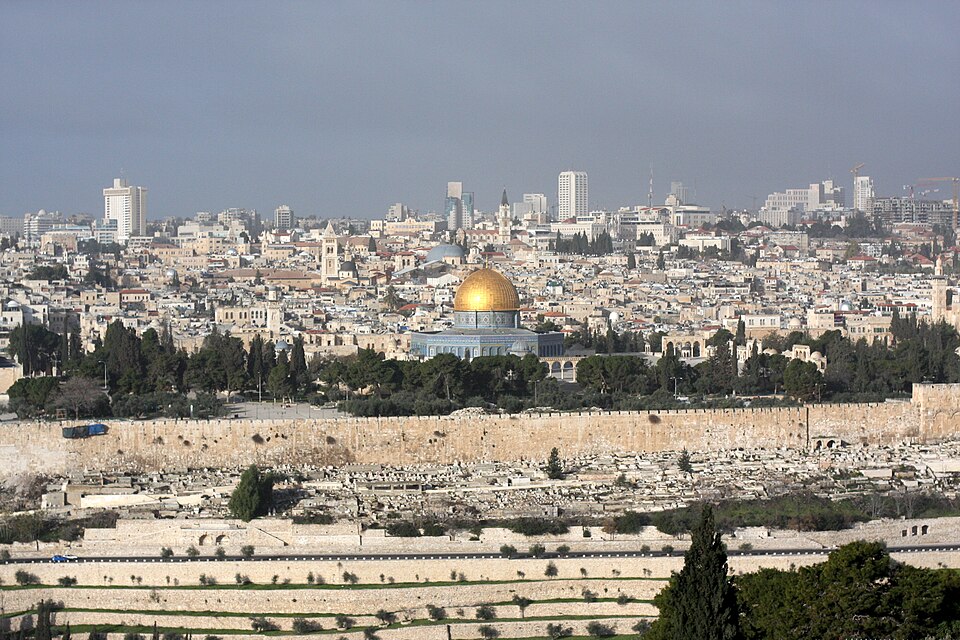
In ruins: c. 586 BC – c. 539 BC
Burnt by Nebuchadnezzar's army (587 or 586 BC, the year is disputed); the exiles returned under Cyrus in 538 BC. In AD 70 Titus's army destroyed the city and the Temple; a Roman legion camped in the ruins until Aelia Capitolina was built c. AD 130.
Events
- c. 1850 BCEgyptian execration texts name Jerusalem (Rushalimum)
- c. 1340 BCAbdi-Heba of Jerusalem writes to Pharaoh (the Amarna letters)
- c. 966 BCSolomon begins building the Temple
- c. 622 BCThe book of the law is found in the Temple; Josiah's reform
- c. 600 BCSilver amulets from Ketef Hinnom carry the priestly blessing, the oldest known text of the Bible
- 520 BCHaggai and Zechariah urge the rebuilding of the Temple; the work resumes
- c. 516 BCThe Second Temple completed and dedicated
- c. 445 BCNehemiah rebuilds the walls of Jerusalem
- c. 175 BCThe high priest Jason builds a gymnasium in Jerusalem
- 167 BCAntiochus IV defiles the Temple
- 164 BCJudas Maccabeus rededicates the Temple
- 152 BCJonathan becomes high priest
- 142 BCUnder Simon, Judea is freed from Seleucid tribute
- 54 BCCrassus plunders the treasures of the Temple
- 40 BCThe Parthians take Jerusalem and make Antigonus king
- 37 BCHerod the Great takes Jerusalem
- c. 20 BCHerod begins rebuilding the Temple
- AD 6Judea becomes a Roman province
- c. AD 49The Council of Jerusalem
- AD 62The high priest Ananus has James, the brother of the Lord, stoned
- AD 135Bar Kokhba's revolt is crushed; Jews are barred from Jerusalem, now Aelia Capitolina
- AD 363Julian's attempt to rebuild the Temple in Jerusalem fails
- c. AD 543Justinian's New Church of the Mother of God (the Nea) is dedicated in Jerusalem
- AD 614The Persians take Jerusalem and carry off the relic of the Cross
- c. AD 630Heraclius brings the relic of the Cross back to Jerusalem
- c. AD 638Jerusalem surrenders to the caliph Umar
- c. AD 691The Dome of the Rock is built on the Temple Mount
- AD 1099The First Crusade takes Jerusalem
- AD 1187Jerusalem surrenders to Saladin
- AD 1229By treaty with al-Kamil, Frederick II recovers Jerusalem without a battle
- AD 1244Khwarazmian troops take and sack Jerusalem
- AD 1267Nahmanides arrives in Jerusalem and restores a synagogue
Battles and sieges
- c. 1003 BCDavid takes the stronghold of Zion 2 Sam 5:6–9
David and his men against the Jebusites of Jerusalem. The stronghold is taken and becomes the city of David. - c. 734 BCRezin and Pekah besiege Ahaz in Jerusalem 2 Kgs 16:5
Rezin of Syria and Pekah of Israel against Ahaz of Judah. They cannot overcome him; Ahaz buys the help of Tiglath-pileser, who takes Damascus. - 701 BCSennacherib's army before Jerusalem 2 Kgs 19:32–36
The Assyrian host under Tartan, Rabsaris and Rab-shakeh against Hezekiah in Jerusalem. The angel of the Lord smites 185,000 in the camp; Sennacherib goes home to Nineveh. - 597 BCJerusalem surrenders to Nebuchadnezzar; Jehoiachin exiled 2 Kgs 24:10–17
Nebuchadnezzar's servants, then the king himself, against Jehoiachin in Jerusalem. Jehoiachin goes out to the king of Babylon; the treasures and ten thousand captives are carried away, and Zedekiah is made king. - c. 586 BCNebuchadnezzar takes and burns Jerusalem 2 Kgs 25:1–10
Nebuchadnezzar and all his host against Zedekiah in Jerusalem. After eighteen months the wall is breached; Zedekiah is caught near Jericho and blinded, the Temple and city are burned, the walls broken down. - 63 BCPompey takes the Temple mount
Pompey's legions, admitted to the city by Hyrcanus's party, against Aristobulus's men holding the Temple. After three months the Temple is stormed on a fast day; Pompey enters the Holy of Holies, and Judea comes under Rome. - AD 70Titus takes Jerusalem; the Temple burns
Four Roman legions under Titus against the Jewish factions of John of Gischala and Simon bar Giora. After a siege from spring to late summer the Temple burns on 10 Loos (Av) and the Upper City falls a month later; the city is razed.
In ancient writers
- Tacitus, Histories 5.11–12 — On the eve of Titus's assault: two high hills fenced by angled walls, towers of 60 to 120 feet, the tower Antonia, and a temple like a citadel with its own walls, a spring and cisterns built for a long siege.
- Josephus, Jewish War 5.136–141 — The city stood on two facing hills divided by a valley and had three walls where ravines did not protect it; the higher hill, the Upper City, David had called the Citadel, the lower was the Acra.
- Pliny the Elder, Natural History 5.70 — Listing the toparchies of Judea, Pliny names Orina, where Jerusalem formerly stood, by far the most famous city not of Judea only but of the whole East.
Questions
- When did Assyria besiege Jerusalem?
- When did Babylon destroy Jerusalem?
- When did Rome destroy the Temple in Jerusalem?
- When was Solomon's Temple built?
- When was the second Temple built?
- Who ruled Judea when Jesus was crucified?
History
Jerusalem lies in the hills of Judah, on the watershed between the Mediterranean and the Dead Sea. People lived beside its spring, the Gihon, from the Early Bronze Age, and Egyptian texts of the second millennium BC already name the city; in the fourteenth century BC its ruler Abdi-Heba wrote to Pharaoh in the Amarna letters. In the Bible it is the city of the Jebusites that David takes and makes his capital, the City of David.
Solomon built the Temple on the hill to the north. Under the kings of Judah the city grew westward. Before Sennacherib's campaign of 701 BC, which both the Assyrian annals and the Bible record, Hezekiah, the Bible says, brought the water of the Gihon into the city through a tunnel, and Jerusalem was not taken. In 587 or 586 BC (the year is disputed) Nebuchadnezzar's army burned the city and the Temple.
Exiles returned under Cyrus in 538 BC; the Second Temple was finished about 516 BC and Nehemiah rebuilt the walls in 445 BC. After Alexander the city passed to the Ptolemies and then the Seleucids, and the Maccabees rededicated the Temple in 164 BC. Herod the Great rebuilt the Temple on a vast platform: this is the Jerusalem of the Gospels and of the first church in Acts.
In AD 70 the army of Titus destroyed the city and the Temple. Hadrian refounded it as the Roman colony of Aelia Capitolina; Cassius Dio makes the foundation a cause of Bar Kokhba's revolt (132-135), while Eusebius places it after the revolt, so the order is disputed. Under Constantine it became a Christian city of pilgrimage, and the Church of the Holy Sepulchre was dedicated in 335.
Scripture: 2 Sam 5:6–9; 1 Kgs 6:1; 2 Kgs 20:20; 2 Kgs 25:8–10; Ezra 6:15; Neh 6:15; Acts 2:1–5
Sources
- Amarna letters EA 285-290 (Abdi-Heba of Jerusalem)
- Sennacherib's Annals (the Taylor Prism); the Siloam Inscription
- Josephus, Jewish War 5.136-247; 6.249-266
- Cassius Dio, Roman History 69.12-14
- Eusebius, Church History 4.6; Life of Constantine 3.25-40; 4.43-47
- 'Jerusalem', in E. Stern (ed.), The New Encyclopedia of Archaeological Excavations in the Holy Land, vol. 2 (1993)
Checked against its sources; not yet read by a historian.
Verses (955)
- Josh 10:1
- Now it came to pass, when Adoni-zedek king of Jerusalem had heard how Joshua had taken Ai, and had utterly destroyed it; as he had done to Jericho and her king, so he had done to Ai and her king; and how the inhabitants of Gibeon had made peace with Israel, and were among them;
- Josh 10:2
- That they feared greatly, because Gibeon was a great city, as one of the royal cities, and because it was greater than Ai, and all the men thereof were mighty.
- Josh 10:3
- Wherefore Adoni-zedek king of Jerusalem sent unto Hoham king of Hebron, and unto Piram king of Jarmuth, and unto Japhia king of Lachish, and unto Debir king of Eglon, saying,
- Josh 10:5
- Therefore the five kings of the Amorites, the king of Jerusalem, the king of Hebron, the king of Jarmuth, the king of Lachish, the king of Eglon, gathered themselves together, and went up, they and all their hosts, and encamped before Gibeon, and made war against it.
- Josh 10:23
- And they did so, and brought forth those five kings unto him out of the cave, the king of Jerusalem, the king of Hebron, the king of Jarmuth, the king of Lachish, and the king of Eglon.
- Josh 12:10
- The king of Jerusalem, one; the king of Hebron, one;
- Josh 15:8
- And the border went up by the valley of the son of Hinnom unto the south side of the Jebusite; the same is Jerusalem: and the border went up to the top of the mountain that lieth before the valley of Hinnom westward, which is at the end of the valley of the giants northward:
- Josh 15:63
- As for the Jebusites the inhabitants of Jerusalem, the children of Judah could not drive them out: but the Jebusites dwell with the children of Judah at Jerusalem unto this day.
- Josh 18:28
- And Zelah, Eleph, and Jebusi, which is Jerusalem, Gibeath, and Kirjath; fourteen cities with their villages. This is the inheritance of the children of Benjamin according to their families.
- Judg 1:7
- And Adoni-bezek said, Threescore and ten kings, having their thumbs and their great toes cut off, gathered their meat under my table: as I have done, so God hath requited me. And they brought him to Jerusalem, and there he died.
- Judg 1:8
- Now the children of Judah had fought against Jerusalem, and had taken it, and smitten it with the edge of the sword, and set the city on fire.
- Judg 1:21
- And the children of Benjamin did not drive out the Jebusites that inhabited Jerusalem; but the Jebusites dwell with the children of Benjamin in Jerusalem unto this day.
- Judg 19:10
- But the man would not tarry that night, but he rose up and departed, and came over against Jebus, which is Jerusalem; and there were with him two asses saddled, his concubine also was with him.
- 1 Sam 17:54
- And David took the head of the Philistine, and brought it to Jerusalem; but he put his armour in his tent.
- 2 Sam 5:5
- In Hebron he reigned over Judah seven years and six months: and in Jerusalem he reigned thirty and three years over all Israel and Judah.
- 2 Sam 5:6
- And the king and his men went to Jerusalem unto the Jebusites, the inhabitants of the land: which spake unto David, saying, Except thou take away the blind and the lame, thou shalt not come in hither: thinking, David cannot come in hither.
- 2 Sam 5:13
- And David took him more concubines and wives out of Jerusalem, after he was come from Hebron: and there were yet sons and daughters born to David.
- 2 Sam 5:14
- And these be the names of those that were born unto him in Jerusalem; Shammua, and Shobab, and Nathan, and Solomon,
- 2 Sam 8:7
- And David took the shields of gold that were on the servants of Hadadezer, and brought them to Jerusalem.
- 2 Sam 9:13
- So Mephibosheth dwelt in Jerusalem: for he did eat continually at the king’s table; and was lame on both his feet.
- 2 Sam 10:14
- And when the children of Ammon saw that the Syrians were fled, then fled they also before Abishai, and entered into the city. So Joab returned from the children of Ammon, and came to Jerusalem.
- 2 Sam 11:1
- And it came to pass, after the year was expired, at the time when kings go forth to battle, that David sent Joab, and his servants with him, and all Israel; and they destroyed the children of Ammon, and besieged Rabbah. But David tarried still at Jerusalem.
- 2 Sam 11:12
- And David said to Uriah, Tarry here to day also, and to morrow I will let thee depart. So Uriah abode in Jerusalem that day, and the morrow.
- 2 Sam 11:22
- So the messenger went, and came and shewed David all that Joab had sent him for.
- 2 Sam 12:31
- And he brought forth the people that were therein, and put them under saws, and under harrows of iron, and under axes of iron, and made them pass through the brickkiln: and thus did he unto all the cities of the children of Ammon. So David and all the people returned unto Jerusalem.
- 2 Sam 13:30
- And it came to pass, while they were in the way, that tidings came to David, saying, Absalom hath slain all the king’s sons, and there is not one of them left.
- 2 Sam 13:34
- But Absalom fled. And the young man that kept the watch lifted up his eyes, and looked, and, behold, there came much people by the way of the hill side behind him.
- 2 Sam 14:23
- So Joab arose and went to Geshur, and brought Absalom to Jerusalem.
- 2 Sam 14:28
- So Absalom dwelt two full years in Jerusalem, and saw not the king’s face.
- 2 Sam 15:8
- For thy servant vowed a vow while I abode at Geshur in Syria, saying, If the LORD shall bring me again indeed to Jerusalem, then I will serve the LORD.
King James Version
Tours through this place
- The life of David
- Absalom's revolt
- Solomon
- The kingdom divides
- The fall of Israel
- Hezekiah and Isaiah
- Jeremiah the prophet
- Josiah's reform
- Daniel
- Ezekiel among the exiles
- The fall of Jerusalem and the exile
- The first return and the second Temple
- The return: Ezra and Nehemiah
- The childhood of Jesus, after Luke
- The life of Jesus
- Jesus in Jerusalem, after John
- The resurrection and the appearances
- Philip the evangelist
- The conversion of Saul
- The apostle Peter
- Paul's second journey
- Paul's third journey
- Paul's arrest and trials