 History Globe
town or village
Rabbah
- Today Amman
Battles and sieges
- c. 990 BCJoab and David take Rabbah of the Ammonites 2 Sam 12:26–31
Joab's army, then David with all the people, against Rabbah. The royal city falls; the king's crown is set on David's head and great spoil is carried out.
History
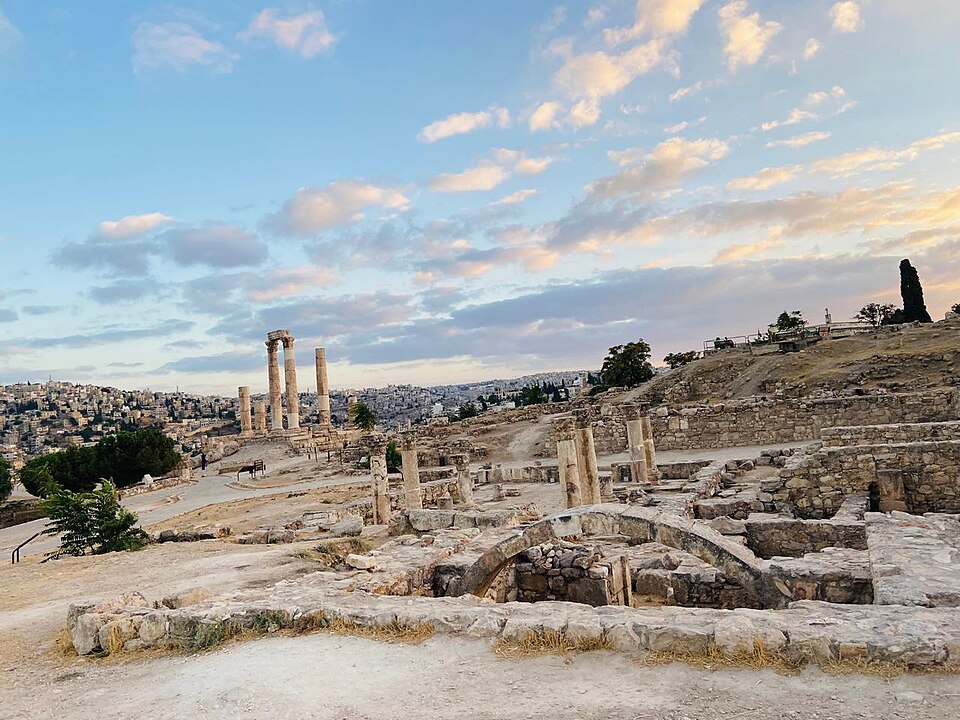
Rabbah, the chief city of the Ammonites, stood on the hill now called the Citadel in the centre of Amman, the capital of Jordan, above the stream that forms the upper course of the Jabbok. People lived on the hill long before the Iron Age, from the Bronze Age on. In the Iron Age it was the capital of the kingdom of Ammon; an inscription from the Citadel is among the oldest known texts in the Ammonite language. In the 730s BC Sanipu of Ammon is listed among the kings who paid tribute to Tiglath-pileser III of Assyria.
Deuteronomy says that the iron bedstead of Og, king of Bashan, was kept in Rabbah of the children of Ammon. After the Ammonite king Hanun shamed David's envoys, Joab besieged Rabbah, and at David's order Uriah the Hittite was left to die in the fighting before its wall. Joab took "the city of waters" and called David, who captured the city and took the crown of its king. Later Shobi the son of Nahash, of Rabbah, brought supplies to David at Mahanaim. Amos, Jeremiah and Ezekiel foretold judgement on Rabbah, and Ezekiel pictures the king of Babylon at a parting of the ways, choosing between Rabbah and Jerusalem.
In the third century BC the city was renamed Philadelphia after Ptolemy II Philadelphus of Egypt. In 218 BC the Seleucid king Antiochus III besieged it; Polybius relates that it fell only when a prisoner showed the attackers the underground passage by which the defenders went down for water, and the attackers blocked it. In the 130s BC, Josephus says, a certain Zeno Cotylas was tyrant of Philadelphia. Pliny counts it among the cities of the Decapolis, and at the outbreak of the Jewish revolt in AD 66 Jewish bands fell on Philadelphia and other neighbouring cities.
When the Nabataean kingdom was annexed in AD 106, Philadelphia became part of the Roman province of Arabia. In the second century it was rebuilt with a large theatre, a nymphaeum, colonnaded streets and a great temple on the Citadel, usually called the Temple of Hercules. Early in the fourth century Eusebius wrote that Rabbath, the city of the king of Ammon, was now Philadelphia, a famous city of Arabia. Churches were built there in the Byzantine period, and after the Arab conquest in the seventh century the old name returned as Amman.
Scripture: Deut 3:11; 2 Sam 10:1–5; 2 Sam 11:1; 2 Sam 11:14–17; 2 Sam 12:26–31; 2 Sam 17:27–29; Amos 1:14; Jer 49:2–3; Ezek 21:20–22; Ezek 25:5
Sources
- Tiglath-pileser III, Summary Inscription 7 (RINAP 1, Tiglath-pileser III 47) rev. 10'-11' (Sanipu of Bit-Ammon)
- Polybius, Histories 5.71.4-11 (the siege of Rabbatamana, 218 BC)
- Josephus, Antiquities 13.235; Jewish War 1.60 (Zeno Cotylas); Jewish War 2.458
- Pliny the Elder, Natural History 5.74 (Philadelphia in the Decapolis)
- Cassius Dio, Roman History 68.14.5 (the annexation of Arabia)
- Eusebius, Onomasticon, s.v. Amman; Ammon; Rabbath
- B. MacDonald and R. W. Younker (eds.), Ancient Ammon (1999)
- A. Northedge, Studies on Roman and Islamic 'Amman, vol. 1 (1992)
Checked against its sources; not yet read by a historian.
Verses (17)
- Deut 3:11
- For only Og king of Bashan remained of the remnant of giants; behold, his bedstead was a bedstead of iron; is it not in Rabbath of the children of Ammon? nine cubits was the length thereof, and four cubits the breadth of it, after the cubit of a man.
- Josh 13:25
- And their coast was Jazer, and all the cities of Gilead, and half the land of the children of Ammon, unto Aroer that is before Rabbah;
- 2 Sam 11:1
- And it came to pass, after the year was expired, at the time when kings go forth to battle, that David sent Joab, and his servants with him, and all Israel; and they destroyed the children of Ammon, and besieged Rabbah. But David tarried still at Jerusalem.
- 2 Sam 12:26
- And Joab fought against Rabbah of the children of Ammon, and took the royal city.
- 2 Sam 12:27
- And Joab sent messengers to David, and said, I have fought against Rabbah, and have taken the city of waters.
- 2 Sam 12:29
- And David gathered all the people together, and went to Rabbah, and fought against it, and took it.
- 2 Sam 12:31
- And he brought forth the people that were therein, and put them under saws, and under harrows of iron, and under axes of iron, and made them pass through the brickkiln: and thus did he unto all the cities of the children of Ammon. So David and all the people returned unto Jerusalem.
- 2 Sam 17:27
- And it came to pass, when David was come to Mahanaim, that Shobi the son of Nahash of Rabbah of the children of Ammon, and Machir the son of Ammiel of Lo-debar, and Barzillai the Gileadite of Rogelim,
- 1 Chr 20:1
- And it came to pass, that after the year was expired, at the time that kings go out to battle, Joab led forth the power of the army, and wasted the country of the children of Ammon, and came and besieged Rabbah. But David tarried at Jerusalem. And Joab smote Rabbah, and destroyed it.
- 1 Chr 20:2
- And David took the crown of their king from off his head, and found it to weigh a talent of gold, and there were precious stones in it; and it was set upon David’s head: and he brought also exceeding much spoil out of the city.
- 1 Chr 20:3
- And he brought out the people that were in it, and cut them with saws, and with harrows of iron, and with axes. Even so dealt David with all the cities of the children of Ammon. And David and all the people returned to Jerusalem.
- Jer 49:2
- Therefore, behold, the days come, saith the LORD, that I will cause an alarm of war to be heard in Rabbah of the Ammonites; and it shall be a desolate heap, and her daughters shall be burned with fire: then shall Israel be heir unto them that were his heirs, saith the LORD.
- Jer 49:3
- Howl, O Heshbon, for Ai is spoiled: cry, ye daughters of Rabbah, gird you with sackcloth; lament, and run to and fro by the hedges; for their king shall go into captivity, and his priests and his princes together.
- Ezek 21:20
- Appoint a way, that the sword may come to Rabbath of the Ammonites, and to Judah in Jerusalem the defenced.
- Ezek 21:21
- For the king of Babylon stood at the parting of the way, at the head of the two ways, to use divination: he made his arrows bright, he consulted with images, he looked in the liver.
- Ezek 25:5
- And I will make Rabbah a stable for camels, and the Ammonites a couchingplace for flocks: and ye shall know that I am the LORD.
- Amos 1:14
- But I will kindle a fire in the wall of Rabbah, and it shall devour the palaces thereof, with shouting in the day of battle, with a tempest in the day of the whirlwind:
King James Version