 History Globe
town or village
Capernaum
- Today Tell Hum
Lifetime: c. 150 BC – …
The fishing village was founded in the Hasmonean period, in the 2nd century BC.
Questions
History
Capernaum lay on the northern shore of the Sea of Galilee, west of where the Jordan enters the lake, at the site now called Tell Hum. Excavations show that the fishing village was founded in the Hasmonean period, in the second century BC. It stretched along the shore, its houses built of black basalt around shared courtyards, and it lived from fishing, farming and the road that passed nearby. Josephus mentions a village Kepharnokon, usually taken to be Capernaum, and a spring called by its name.
In the Gospels Capernaum is the base of Jesus' ministry in Galilee, called his own city. He taught in its synagogue, healed the mother-in-law of Simon Peter, a paralysed man let down through a roof and the servant of a centurion who, Luke says, had built the synagogue. He called Levi from the tax office there, and later reproached the town for not repenting.
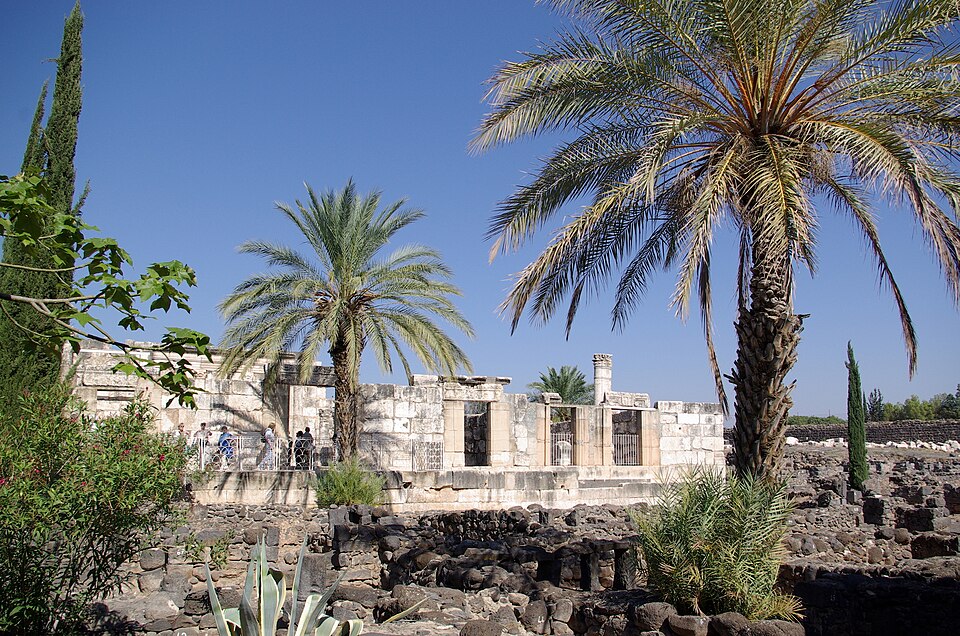
Franciscan excavations led by Virgilio Corbo and Stanislao Loffreda from 1968, and Greek Orthodox excavations under Vassilios Tzaferis on the eastern part of the site, uncovered the village. Beneath the later synagogue lie basalt foundations that may belong to a first-century synagogue. Nearby, one room of a first-century house was plastered and became a meeting place; Christian graffiti were scratched on its walls, and it was long venerated as the house of Peter.
In the fourth century the room lay at the heart of an enclosed house church, and a pilgrim's account of the 380s, preserved by Peter the Deacon and usually ascribed to Egeria, tells of the house of the apostle made into a church and of a synagogue of dressed stone reached by many steps. Epiphanius says that Joseph of Tiberias had leave from Constantine to build churches in Capernaum and other Jewish towns. In the mid-fifth century an octagonal church replaced the house church. The white limestone synagogue nearby is dated by coins beneath its floor to the late fourth or fifth century, though an earlier date has also been argued.
Scripture: Matt 4:13; Matt 9:1; Mark 1:21; Mark 1:29–31; Mark 2:1–12; Mark 2:13–14; Luke 7:1–10; Matt 11:23
Sources
- Josephus, Life 403; Jewish War 3.519
- Egeria, Itinerarium, as excerpted by Peter the Deacon, De locis sanctis (the Capernaum passage); J. Wilkinson, Egeria's Travels (3rd ed. 1999)
- Epiphanius, Panarion 30.11-12
- V. C. Corbo, Cafarnao I: Gli edifici della città (1975)
- S. Loffreda, Recovering Capharnaum (1985)
- V. Tzaferis, Excavations at Capernaum I: 1978-1982 (1989)
- 'Capernaum', in E. Stern (ed.), The New Encyclopedia of Archaeological Excavations in the Holy Land, vol. 1 (1993)
Checked against its sources; not yet read by a historian.
Verses (18)
- Matt 4:13
- And leaving Nazareth, he came and dwelt in Capernaum, which is upon the sea coast, in the borders of Zabulon and Nephthalim:
- Matt 8:5
- And when Jesus was entered into Capernaum, there came unto him a centurion, beseeching him,
- Matt 11:23
- And thou, Capernaum, which art exalted unto heaven, shalt be brought down to hell: for if the mighty works, which have been done in thee, had been done in Sodom, it would have remained until this day.
- Matt 17:24
- And when they were come to Capernaum, they that received tribute money came to Peter, and said, Doth not your master pay tribute?
- Mark 1:21
- And they went into Capernaum; and straightway on the sabbath day he entered into the synagogue, and taught.
- Mark 2:1
- And again he entered into Capernaum after some days; and it was noised that he was in the house.
- Mark 9:33
- And he came to Capernaum: and being in the house he asked them, What was it that ye disputed among yourselves by the way?
- Mark 10:1
- And he arose from thence, and cometh into the coasts of Judæa by the farther side of Jordan: and the people resort unto him again; and, as he was wont, he taught them again.
- Luke 4:23
- And he said unto them, Ye will surely say unto me this proverb, Physician, heal thyself: whatsoever we have heard done in Capernaum, do also here in thy country.
- Luke 4:31
- And came down to Capernaum, a city of Galilee, and taught them on the sabbath days.
- Luke 7:1
- Now when he had ended all his sayings in the audience of the people, he entered into Capernaum.
- Luke 10:15
- And thou, Capernaum, which art exalted to heaven, shalt be thrust down to hell.
- John 2:12
- After this he went down to Capernaum, he, and his mother, and his brethren, and his disciples: and they continued there not many days.
- John 4:46
- So Jesus came again into Cana of Galilee, where he made the water wine. And there was a certain nobleman, whose son was sick at Capernaum.
- John 4:47
- When he heard that Jesus was come out of Judæa into Galilee, he went unto him, and besought him that he would come down, and heal his son: for he was at the point of death.
- John 6:17
- And entered into a ship, and went over the sea toward Capernaum. And it was now dark, and Jesus was not come to them.
- John 6:24
- When the people therefore saw that Jesus was not there, neither his disciples, they also took shipping, and came to Capernaum, seeking for Jesus.
- John 6:59
- These things said he in the synagogue, as he taught in Capernaum.
King James Version