 History Globe
town or village
City of David
In ruins: c. 586 BC – c. 539 BC
Burnt with the rest of Jerusalem by Nebuchadnezzar's army; the burnt houses were found in Yigal Shiloh's excavations. The exiles returned after the decree of Cyrus in 538 BC.
History
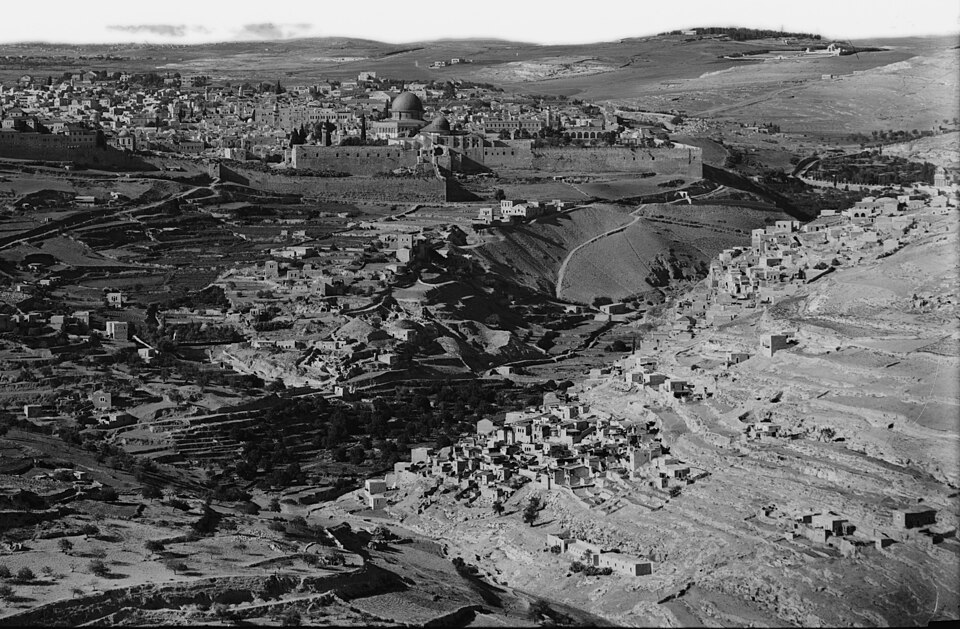
The City of David is the narrow ridge running south from the Temple Mount, between the Kidron valley and the central valley that Josephus calls the Valley of the Cheesemongers. At its eastern foot rises the Gihon, the only spring of ancient Jerusalem, which is why the oldest town stood here. Pottery shows people here from the Chalcolithic and Early Bronze Age. Radiocarbon dates put the first public buildings early in the nineteenth century BC, and a massive tower was built round the spring; its excavators, Ronny Reich and Eli Shukron, date it to the Middle Bronze Age, while later samples allow a date in the late ninth century BC, so its date is disputed.
Charles Warren explored the ridge in 1867 and found the vertical shaft beside the spring that bears his name; it was long taken for the Jebusite water shaft and, on one reading of 2 Samuel 5:8, for the way by which David's men got in. Excavations followed under Parker and Vincent, Weill, Macalister and Duncan, Kathleen Kenyon (1961–1967), Yigal Shiloh (1978–1985) and, from 1995, Reich and Shukron, who showed that the shaft is a natural fissure and that the Bronze Age approach to the spring was a fortified passage. Eilat Mazar's Large Stone Structure, uncovered in 2005, was presented as David's palace of the tenth century BC; others date parts of it much later and doubt that it was one building, and the question is disputed.
Before the Assyrian threat Hezekiah "stopped the upper watercourse of Gihon, and brought it straight down to the west side of the city of David". The winding tunnel, some 533 m long, carries the spring to the Pool of Siloam. In 1880 an inscription was found in it telling how two teams of hewers, cutting towards each other, heard each other's voices and met, and how the water then flowed 1,200 cubits to the pool; it is now in the Istanbul Archaeological Museum. Radiometric dating gives an Iron Age date in keeping with the Bible; Reich and Shukron have argued that it was cut earlier, about 800 BC, so the attribution to Hezekiah is disputed.
After the exile Nehemiah's builders repaired the wall down to "the stairs that go down from the city of David". In the Second Temple period the ridge was part of the Lower City, and Jesus sent the blind man to wash in the pool of Siloam. For centuries after AD 70 Siloam lay outside the city wall. In the fifth century a new wall, credited by the Piacenza pilgrim to the Empress Eudocia, brought it back within the city, and by the sixth century a basilica stood over the pool.
Scripture: 2 Sam 5:6–9; 1 Kgs 1:33–38; 2 Kgs 20:20; 2 Chr 32:30; Neh 3:15; John 9:7
Sources
- Josephus, Jewish War 5.137-145 (the upper and lower city, the Valley of the Cheesemongers, Siloam)
- The Siloam Inscription (KAI 189)
- Bordeaux Pilgrim, Itinerarium Burdigalense 592 (Siloam by the wall, AD 333); Piacenza Pilgrim, Itinerarium 24-25 (the basilica at Siloam; Eudocia's wall), in P. Geyer, Itinera Hierosolymitana (CSEL 39, 1898), p. 176
- C. Warren and C. W. Wilson, The Recovery of Jerusalem (1871)
- Y. Shiloh, Excavations at the City of David (Qedem 19, 1984)
- R. Reich and E. Shukron, Excavations in the City of David, Jerusalem (1995-2010) (2021); R. Reich, 'The Date of the Gihon Spring Tower in Jerusalem', Tel Aviv 45 (2018) 114-119; J. Regev et al., 'Absolute Dating of the Gihon Spring Fortifications, Jerusalem', Radiocarbon 59 (2017) 1171-1193; J. Regev et al., 'Middle Bronze Age Jerusalem: Recalculating its Character and Chronology', Radiocarbon 63 (2021) 853-883
- A. Frumkin, A. Shimron and J. Rosenbaum, 'Radiometric Dating of the Siloam Tunnel, Jerusalem', Nature 425 (2003) 169-171; R. Reich and E. Shukron, 'The Date of the Siloam Tunnel Reconsidered', Tel Aviv 38 (2011) 147-157
- E. Mazar, Preliminary Report on the City of David Excavations 2005 at the Visitors Center Area (2007); I. Finkelstein, Z. Herzog, L. Singer-Avitz and D. Ussishkin, 'Has King David's Palace in Jerusalem Been Found?', Tel Aviv 34 (2007) 142-164
Checked against its sources; not yet read by a historian.
Verses (46)
- 2 Sam 5:7
- Nevertheless David took the strong hold of Zion: the same is the city of David.
- 2 Sam 5:9
- So David dwelt in the fort, and called it the city of David. And David built round about from Millo and inward.
- 2 Sam 6:10
- So David would not remove the ark of the LORD unto him into the city of David: but David carried it aside into the house of Obed-edom the Gittite.
- 2 Sam 6:12
- And it was told king David, saying, The LORD hath blessed the house of Obed-edom, and all that pertaineth unto him, because of the ark of God. So David went and brought up the ark of God from the house of Obed-edom into the city of David with gladness.
- 2 Sam 6:16
- And as the ark of the LORD came into the city of David, Michal Saul’s daughter looked through a window, and saw king David leaping and dancing before the LORD; and she despised him in her heart.
- 1 Kgs 2:10
- So David slept with his fathers, and was buried in the city of David.
- 1 Kgs 3:1
- And Solomon made affinity with Pharaoh king of Egypt, and took Pharaoh’s daughter, and brought her into the city of David, until he had made an end of building his own house, and the house of the LORD, and the wall of Jerusalem round about.
- 1 Kgs 8:1
- Then Solomon assembled the elders of Israel, and all the heads of the tribes, the chief of the fathers of the children of Israel, unto king Solomon in Jerusalem, that they might bring up the ark of the covenant of the LORD out of the city of David, which is Zion.
- 1 Kgs 9:24
- But Pharaoh’s daughter came up out of the city of David unto her house which Solomon had built for her: then did he build Millo.
- 1 Kgs 11:27
- And this was the cause that he lifted up his hand against the king: Solomon built Millo, and repaired the breaches of the city of David his father.
- 1 Kgs 11:43
- And Solomon slept with his fathers, and was buried in the city of David his father: and Rehoboam his son reigned in his stead.
- 1 Kgs 14:31
- And Rehoboam slept with his fathers, and was buried with his fathers in the city of David. And his mother’s name was Naamah an Ammonitess. And Abijam his son reigned in his stead.
- 1 Kgs 15:8
- And Abijam slept with his fathers; and they buried him in the city of David: and Asa his son reigned in his stead.
- 1 Kgs 15:24
- And Asa slept with his fathers, and was buried with his fathers in the city of David his father: and Jehoshaphat his son reigned in his stead.
- 1 Kgs 22:50
- And Jehoshaphat slept with his fathers, and was buried with his fathers in the city of David his father: and Jehoram his son reigned in his stead.
- 2 Kgs 8:24
- And Joram slept with his fathers, and was buried with his fathers in the city of David: and Ahaziah his son reigned in his stead.
- 2 Kgs 9:28
- And his servants carried him in a chariot to Jerusalem, and buried him in his sepulchre with his fathers in the city of David.
- 2 Kgs 12:21
- For Jozachar the son of Shimeath, and Jehozabad the son of Shomer, his servants, smote him, and he died; and they buried him with his fathers in the city of David: and Amaziah his son reigned in his stead.
- 2 Kgs 14:20
- And they brought him on horses: and he was buried at Jerusalem with his fathers in the city of David.
- 2 Kgs 15:7
- So Azariah slept with his fathers; and they buried him with his fathers in the city of David: and Jotham his son reigned in his stead.
- 2 Kgs 15:38
- And Jotham slept with his fathers, and was buried with his fathers in the city of David his father: and Ahaz his son reigned in his stead.
- 2 Kgs 16:20
- And Ahaz slept with his fathers, and was buried with his fathers in the city of David: and Hezekiah his son reigned in his stead.
- 1 Chr 11:5
- And the inhabitants of Jebus said to David, Thou shalt not come hither. Nevertheless David took the castle of Zion, which is the city of David.
- 1 Chr 11:7
- And David dwelt in the castle; therefore they called it the city of David.
- 1 Chr 13:13
- So David brought not the ark home to himself to the city of David, but carried it aside into the house of Obed-edom the Gittite.
- 1 Chr 15:1
- And David made him houses in the city of David, and prepared a place for the ark of God, and pitched for it a tent.
- 1 Chr 15:29
- And it came to pass, as the ark of the covenant of the LORD came to the city of David, that Michal the daughter of Saul looking out at a window saw king David dancing and playing: and she despised him in her heart.
- 2 Chr 5:2
- Then Solomon assembled the elders of Israel, and all the heads of the tribes, the chief of the fathers of the children of Israel, unto Jerusalem, to bring up the ark of the covenant of the LORD out of the city of David, which is Zion.
- 2 Chr 8:11
- And Solomon brought up the daughter of Pharaoh out of the city of David unto the house that he had built for her: for he said, My wife shall not dwell in the house of David king of Israel, because the places are holy, whereunto the ark of the LORD hath come.
- 2 Chr 9:31
- And Solomon slept with his fathers, and he was buried in the city of David his father: and Rehoboam his son reigned in his stead.
King James Version