 History Globe
town or village
Gerasa
- Today Jerash
History
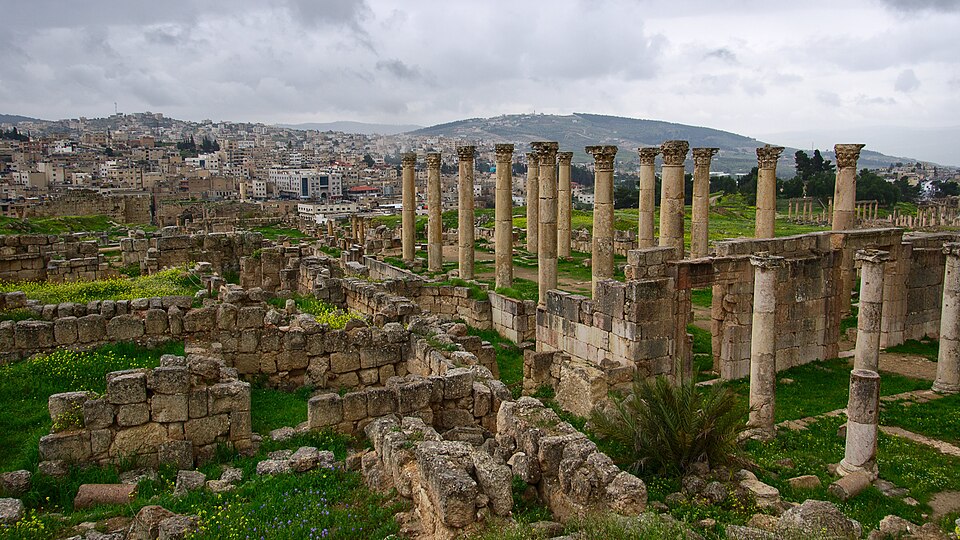
Gerasa, today's Jerash in northern Jordan, lies in the hills of Gilead about 48 km north of Amman, on a stream the Greeks called the Chrysorrhoas, "golden river", which runs down to the Jabbok. The city was a Greek foundation. Later tradition in Gerasa named Alexander the Great or his general Perdiccas as its founder, but its official name, Antioch on the Chrysorrhoas, points to a Seleucid king, probably in the second century BC. Josephus says that Alexander Jannaeus took Gerasa in the early first century BC after building a triple wall around it.
After the Roman conquest of 63 BC Gerasa came under Rome and was counted among the Greek cities of the Decapolis; Pliny lists it as Galasa. When the revolt of AD 66 broke out, Jewish bands laid waste the villages around it, yet, Josephus says, the Gerasenes did no harm to the Jews who stayed and escorted those who wished to leave as far as their borders. After Trajan annexed the Nabataean kingdom in 106, Gerasa belonged to the new province of Arabia. From the late first century and through the second it was rebuilt on a grand scale, with an oval plaza, a colonnaded main street, temples of Zeus and Artemis, theatres and an arch for Hadrian's visit of 129–130.
Mark and Luke tell how Jesus crossed the Sea of Galilee and healed a man possessed by a legion of devils, which entered a herd of swine that ran down a steep place into the lake. The manuscripts name the place differently. The KJV and the Synodal text read Gadarenes in Mark and Luke and Gergesenes in Matthew, while many modern editions read Gerasenes in Mark and Luke and Gadarenes in Matthew. Gerasa lies more than 50 km from the lake, and already Origen preferred Gergesa, an old town by the lake with a steep bank above the water; Eusebius knew a village of that name on the hills by the lake. Mark adds that the healed man proclaimed in Decapolis what Jesus had done for him.
By the fourth century the city had a Christian community. Exeresius, bishop of Gerasa, signed at the Council of Seleucia in 359, and Epiphanius writes that his brethren drank from a stream in the martyrium at Gerasa which, like other springs, was said to turn to wine on the day of the miracle at Cana. A cathedral was built in the fourth century, the first of many churches in the city. Large-scale excavations were carried out from 1928 by Yale University with the British and American schools of archaeology, and Gerasa is now one of the best preserved Roman cities of the Near East.
Scripture: Mark 5:1–20; Luke 8:26–39; Matt 8:28–34
Sources
- Josephus, Jewish War 1.104 (Alexander Jannaeus takes Gerasa); 2.458, 2.480 (the revolt of AD 66)
- Pliny the Elder, Natural History 5.74 (Galasa among the cities of the Decapolis)
- Cassius Dio, Roman History 68.14.5 (annexation of Arabia under Trajan)
- Origen, Commentary on John 6.24 (ANF 10; Gerasa, Gadara and Gergesa)
- Eusebius, Onomasticon, s.v. Gergasei and Gergesa (C. U. Wolf's translation, nos. 304, 363)
- Epiphanius, Panarion 51.30.2 (the stream at the martyrium of Gerasa); 73.26 (Exeresius of Gerasa at Seleucia, 359)
- C. H. Kraeling (ed.), Gerasa: City of the Decapolis (1938), the report of the Yale, British School and ASOR excavations of 1928-1934
- B. M. Metzger, A Textual Commentary on the Greek New Testament (2nd ed., 1994), on Matt 8:28, Mark 5:1, Luke 8:26
Checked against its sources; not yet read by a historian.
Verses (3)
- Mark 5:1
- And they came over unto the other side of the sea, into the country of the Gadarenes.
- Luke 8:26
- And they arrived at the country of the Gadarenes, which is over against Galilee.
- Luke 8:37
- Then the whole multitude of the country of the Gadarenes round about besought him to depart from them; for they were taken with great fear: and he went up into the ship, and returned back again.
King James Version