 History Globe
town or village
Miletus
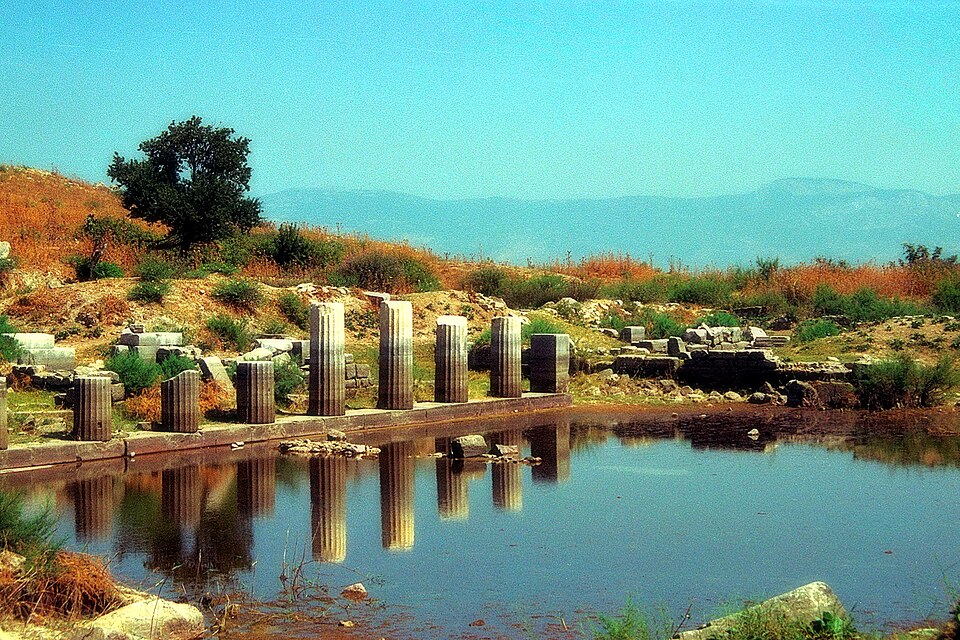
In ruins: 494 BC – c. 480 BC
Taken by the Persians after the battle of Lade in 494 BC: the men were killed, the women and children enslaved, the city emptied; it was rebuilt on a new plan after the Greek victory at Mycale in 479 BC.
Events
- 494 BCThe Persians take Miletus: the Ionian revolt is crushed
History
Miletus stood on a peninsula near the mouth of the Maeander on the west coast of Asia Minor; the river's silt has since left its ruins, by the village of Balat in Turkey, several kilometres inland. Minoan and then Mycenaean settlers lived there in the Bronze Age, and the town is usually identified with Millawanda of the Hittite texts. Strabo records a tradition that Cretans first settled the place and that Neleus and his followers later founded the Ionian city.
In the archaic age Miletus was one of the richest Greek cities. Strabo says it planted colonies all around the Black Sea and the Propontis, and it was the home of Thales, Anaximander and Anaximenes, the first Greek natural philosophers. Miletus led the Ionian revolt against Persia; in 494 BC, after the Ionian fleet was defeated off the island of Lade, the Persians took the city, killed most of the men, enslaved the women and children and burned the sanctuary at Didyma. Rebuilt on a regular grid, Miletus shut its gates against Alexander the Great in 334 BC and was taken by assault.
Under Rome the city had a Jewish community: Josephus preserves a letter in which the proconsul Publius Servilius told the Milesians not to stop the Jews from keeping their Sabbaths and ancestral rites. About AD 57, on his last journey to Jerusalem, Paul sailed past Ephesus and stopped at Miletus. He sent for the elders of the church at Ephesus and gave them his farewell address; they prayed together, grieved that they would not see his face again, and went with him to the ship. Second Timothy says that Paul left Trophimus sick at Miletus.
In the Roman imperial period Miletus was adorned with public buildings: the theatre was greatly enlarged, baths named after the empress Faustina, wife of Marcus Aurelius, were built, and a monumental market gate, now in the Pergamon Museum in Berlin, was set up. Its bishop Eusebius attended the Council of Nicaea in 325. As the Maeander silted up its harbours, the city slowly shrank.
Scripture: Acts 20:15–17; Acts 20:18–35; Acts 20:36–38; 2 Tim 4:20
Sources
- Strabo, Geography 14.1.3; 14.1.6-7
- Herodotus, Histories 6.18-20
- Arrian, Anabasis of Alexander 1.18-19
- Josephus, Antiquities 14.244-246
- Subscriptions of the Council of Nicaea (Eusebius of Miletus), in H. Gelzer, H. Hilgenfeld and O. Cuntz, Patrum Nicaenorum nomina (1898)
- A. M. Greaves, Miletos: A History (2002)
- V. B. Gorman, Miletos, the Ornament of Ionia (2001)
Checked against its sources; not yet read by a historian.
Verses (3)
- Acts 20:15
- And we sailed thence, and came the next day over against Chios; and the next day we arrived at Samos, and tarried at Trogyllium; and the next day we came to Miletus.
- Acts 20:17
- And from Miletus he sent to Ephesus, and called the elders of the church.
- 2 Tim 4:20
- Erastus abode at Corinth: but Trophimus have I left at Miletum sick.
King James Version