 History Globe
town or village
Ephesus
Events
- AD 431The Council of Ephesus deposes Nestorius
In ancient writers
- Strabo, Geography 14.1.22–24 — After Herostratus burned the temple of Artemis the Ephesians built a grander one from the women's jewellery and private gifts; the city has an arsenal and harbour and grows daily, the greatest mart in Asia this side of the Taurus.
- Pliny the Elder, Natural History 36.95 — The temple of Diana at Ephesus, the true wonder of Greek magnificence, took 120 years and all Asia to build on marshy ground against earthquakes, with 127 columns sixty feet high, each the gift of a king.
- Pausanias, Description of Greece 4.31.8 — All cities worship Artemis of Ephesus and individuals honour her above all gods, because of the Amazons, the sanctuary's antiquity, the temple that surpasses every building among men, and the eminence of the city.
Questions
History
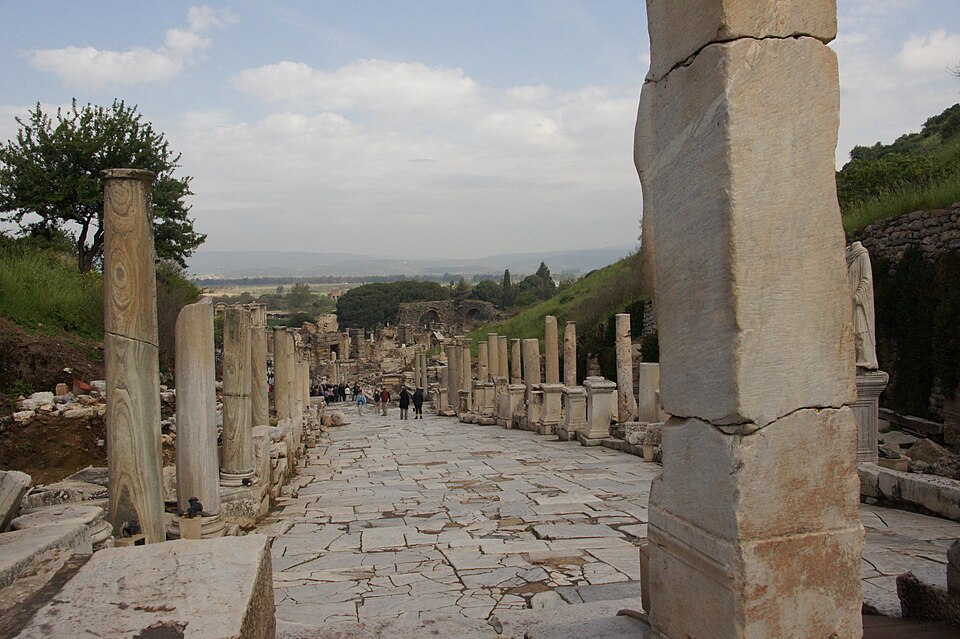
Ephesus lies on the west coast of Asia Minor, near the mouth of the Cayster, by Selçuk in Turkey. Greek tradition held that Ionians led by Androclus, son of the Athenian king Codrus, founded it beside an older shrine. Its fame was the temple of Artemis: Croesus of Lydia, who took the city in the sixth century BC, gave many of its columns. In 356 BC Herostratus set the temple on fire; it was rebuilt and counted among the Seven Wonders.
Alexander took the city from the Persians in 334 BC. About 290 BC Lysimachus moved the people to a new site between the hills, nearer the shifting harbour. In 133 BC Attalus III of Pergamum left his kingdom to Rome, and it became the province of Asia. Under the emperors Ephesus was the residence of the proconsul and one of the largest cities of the East, with a theatre on the slope of Mount Pion.
Paul first stopped here briefly and left Aquila and Priscilla, who taught Apollos. Returning, he argued in the synagogue for three months and then for two years in the school of Tyrannus. The silversmith Demetrius, who made silver shrines of Artemis, stirred up a riot in the theatre until the town clerk calmed the crowd. From Ephesus Paul wrote to the Corinthians; later he called its elders to Miletus. Timothy stayed in the city, the letter to the Ephesians bears its name (some early manuscripts lack the words in Ephesus), and Revelation addresses the first of the seven churches to it.
Early tradition holds that the apostle John lived and was buried at Ephesus, and Ignatius wrote to its church. In the 260s the Goths plundered the city and burned the temple of Artemis. In 431 a council met in the Church of Mary, condemned Nestorius and confirmed the title Theotokos, Mother of God, for Mary; a second council in 449 was overturned at Chalcedon in 451. The silting of the harbour slowly drained the city's trade.
Scripture: Acts 18:19–21; Acts 18:24–26; Acts 19:1–10; Acts 19:23–41; 1 Cor 16:8–9; Acts 20:17–18; 1 Tim 1:3; Eph 1:1; Rev 2:1–7
Sources
- Strabo, Geography 14.1.3-4; 14.1.21-24
- Pausanias, Description of Greece 7.2.6-9
- Herodotus, Histories 1.26; 1.92
- Plutarch, Alexander 3; Pliny, Natural History 36.95-97
- Arrian, Anabasis 1.17.10-12
- Irenaeus, Against Heresies 3.1.1; 3.3.4; Eusebius, Church History 3.23; 3.31.3
- Ignatius, Letter to the Ephesians
- Jordanes, Getica 20.107-108; Historia Augusta, Gallienus 6.2
- Acts of the Council of Ephesus (431); Evagrius, Church History 1.3-5 and 1.10
- H. Koester (ed.), Ephesos, Metropolis of Asia (1995)
- P. Trebilco, The Early Christians in Ephesus from Paul to Ignatius (2004)
Checked against its sources; not yet read by a historian.
Verses (20)
- Acts 18:19
- And he came to Ephesus, and left them there: but he himself entered into the synagogue, and reasoned with the Jews.
- Acts 18:21
- But bade them farewell, saying, I must by all means keep this feast that cometh in Jerusalem: but I will return again unto you, if God will. And he sailed from Ephesus.
- Acts 18:24
- And a certain Jew named Apollos, born at Alexandria, an eloquent man, and mighty in the scriptures, came to Ephesus.
- Acts 18:27
- And when he was disposed to pass into Achaia, the brethren wrote, exhorting the disciples to receive him: who, when he was come, helped them much which had believed through grace:
- Acts 19:1
- And it came to pass, that, while Apollos was at Corinth, Paul having passed through the upper coasts came to Ephesus: and finding certain disciples,
- Acts 19:17
- And this was known to all the Jews and Greeks also dwelling at Ephesus; and fear fell on them all, and the name of the Lord Jesus was magnified.
- Acts 19:23
- And the same time there arose no small stir about that way.
- Acts 19:26
- Moreover ye see and hear, that not alone at Ephesus, but almost throughout all Asia, this Paul hath persuaded and turned away much people, saying that they be no gods, which are made with hands:
- Acts 19:35
- And when the townclerk had appeased the people, he said, Ye men of Ephesus, what man is there that knoweth not how that the city of the Ephesians is a worshipper of the great goddess Diana, and of the image which fell down from Jupiter?
- Acts 20:16
- For Paul had determined to sail by Ephesus, because he would not spend the time in Asia: for he hasted, if it were possible for him, to be at Jerusalem the day of Pentecost.
- Acts 20:17
- And from Miletus he sent to Ephesus, and called the elders of the church.
- Acts 21:29
- (For they had seen before with him in the city Trophimus an Ephesian, whom they supposed that Paul had brought into the temple.)
- 1 Cor 15:32
- If after the manner of men I have fought with beasts at Ephesus, what advantageth it me, if the dead rise not? let us eat and drink; for to morrow we die.
- 1 Cor 16:8
- But I will tarry at Ephesus until Pentecost.
- Eph 1:1
- Paul, an apostle of Jesus Christ by the will of God, to the saints which are at Ephesus, and to the faithful in Christ Jesus:
- 1 Tim 1:3
- As I besought thee to abide still at Ephesus, when I went into Macedonia, that thou mightest charge some that they teach no other doctrine,
- 2 Tim 1:18
- The Lord grant unto him that he may find mercy of the Lord in that day: and in how many things he ministered unto me at Ephesus, thou knowest very well.
- 2 Tim 4:12
- And Tychicus have I sent to Ephesus.
- Rev 1:11
- Saying, I am Alpha and Omega, the first and the last: and, What thou seest, write in a book, and send it unto the seven churches which are in Asia; unto Ephesus, and unto Smyrna, and unto Pergamos, and unto Thyatira, and unto Sardis, and unto Philadelphia, and unto Laodicea.
- Rev 2:1
- Unto the angel of the church of Ephesus write; These things saith he that holdeth the seven stars in his right hand, who walketh in the midst of the seven golden candlesticks;
King James Version