 History Globe
town or village
Smyrna
- Today Izmir
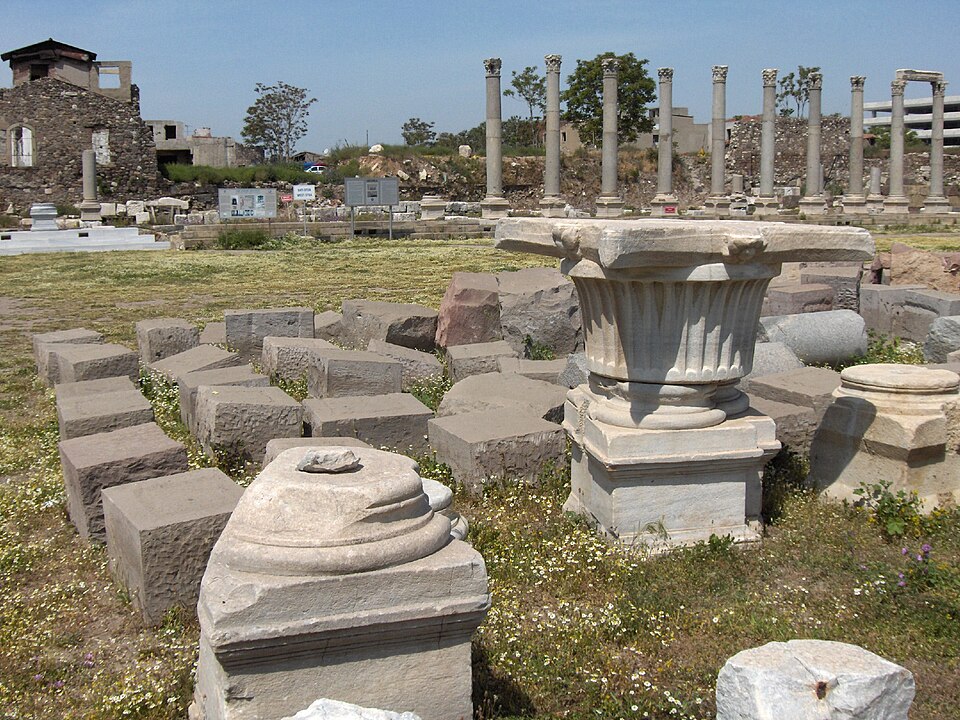
Lifetime: c. 300 BC – …
The Smyrna of Revelation was built anew on the slopes of Mount Pagos about 300 BC, begun by Antigonus and finished by Lysimachus; the older city had stood across the bay at Bayrakli.
In ancient writers
- Strabo, Geography 14.1.37 — After the Lydians razed old Smyrna its people lived in villages for 400 years; restored by Antigonus and Lysimachus, it is now the most beautiful city in Ionia, partly on a hill, mostly on the plain by the harbour.
- Pausanias, Description of Greece 7.5.1 — Smyrna was one of the twelve Aeolian cities until Ionians from Colophon seized it; the modern city was founded by Alexander the son of Philip in accordance with a vision in a dream.
- Eusebius, Church History 4.15 — Eusebius copies the letter of the church of Smyrna: the aged bishop Polycarp refused to swear by the genius of Caesar; in the stadium the crowd of Smyrna cried that he was the teacher of Asia, and when the fire would not consume him he was stabbed.
History
Smyrna, today's İzmir, lies at the head of a long gulf on the Aegean coast of Asia Minor. The older city stood across the bay at Bayraklı, a mound settled since the third millennium BC and excavated by J. M. Cook after 1948. Herodotus says that Smyrna was first Aeolian until exiles from Colophon seized it, making it Ionian, and that the Lydian king Alyattes took it, about 600 BC. For some four hundred years afterwards, Strabo says, its people lived in villages.
The new city rose about 300 BC on the slopes of Mount Pagus: Strabo credits Antigonus and Lysimachus, while Pausanias tells that Alexander was bidden in a dream to found it. Strabo praises its straight paved streets, its porticoes, its library and its shrine of Homer, whom the Smyrnaeans claimed as their own. A loyal ally of Rome, Smyrna built a temple to the City of Rome in 195 BC, the first, as its envoys later told the Senate; in AD 26 the Senate chose it over ten rivals as the site of a temple of Tiberius.
Revelation names Smyrna second among the seven churches of Asia. Its letter speaks of tribulation and poverty, of slander from those who say they are Jews and are not, "but are the synagogue of Satan", and of prison to come, and it promises: "be thou faithful unto death, and I will give thee a crown of life." Early in the second century, by the usual dating, Ignatius of Antioch, taken under guard to Rome, stopped at Smyrna and later wrote to its church and to its bishop Polycarp, who, Irenaeus says, had been appointed by apostles.
Polycarp was burned in the stadium of Smyrna; asked to revile Christ, he answered that he had served him eighty-six years. The letter of the church of Smyrna telling of his death is generally held to be the oldest Christian account of a martyrdom after the New Testament; his death is dated by some to about 155–156 and by others to later years. About 178 an earthquake destroyed much of the city, and Marcus Aurelius gave money and appointed a senator to rebuild it.
Scripture: Rev 1:11; Rev 2:8–11
Sources
- Herodotus, Histories 1.16; 1.149-150
- Strabo, Geography 14.1.37
- Pausanias, Description of Greece 7.5.1-3
- Tacitus, Annals 4.55-56
- Ignatius, Letters to the Smyrnaeans and to Polycarp; Irenaeus, Against Heresies 3.3.4
- Martyrdom of Polycarp 9-16
- Cassius Dio, Roman History 72(71).32.3
- J. M. Cook, 'Old Smyrna, 1948-1951', Annual of the British School at Athens 53-54 (1958-59)
- C. J. Cadoux, Ancient Smyrna (1938)
Checked against its sources; not yet read by a historian.
Verses (2)
- Rev 1:11
- Saying, I am Alpha and Omega, the first and the last: and, What thou seest, write in a book, and send it unto the seven churches which are in Asia; unto Ephesus, and unto Smyrna, and unto Pergamos, and unto Thyatira, and unto Sardis, and unto Philadelphia, and unto Laodicea.
- Rev 2:8
- And unto the angel of the church in Smyrna write; These things saith the first and the last, which was dead, and is alive;
King James Version