 History Globe
town or village
Laodicea
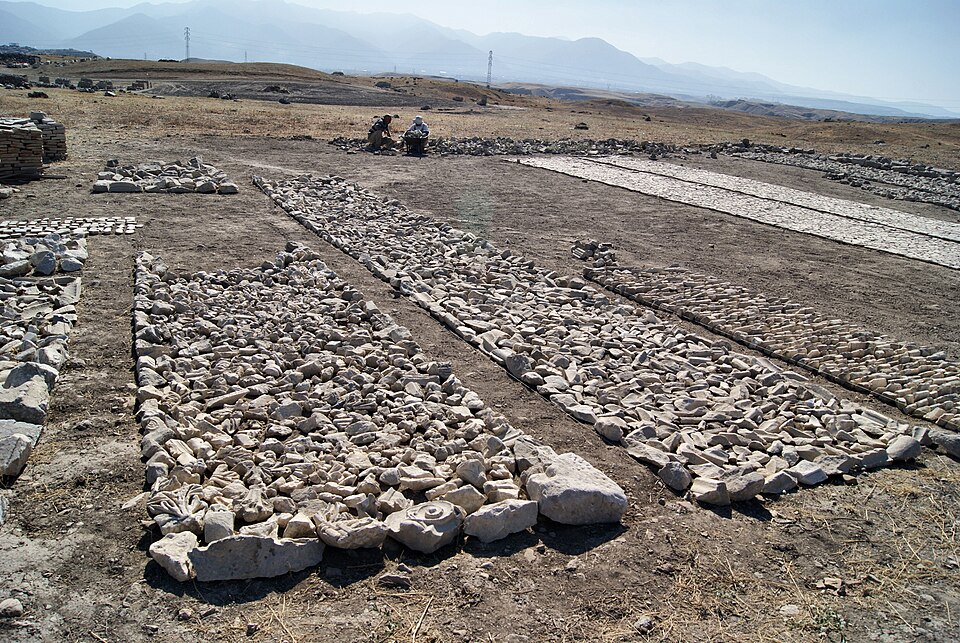
- Today Ruins of Laodicea, by Denizli
Lifetime: c. 260 BC – …
Founded by the Seleucid king Antiochus II and named after his wife Laodice.
In ancient writers
- Strabo, Geography 12.8.16 — Laodicea, formerly a small town, has grown great in Strabo's time despite the siege by Mithridates, thanks to the fertility of its land and the wealth of some of its citizens.
- Tacitus, Annals 14.27 — In AD 60 Laodicea, one of the famous cities of Asia, was overthrown by an earthquake and, without any relief from Rome, recovered by its own resources.
History
Laodicea lay in the valley of the Lycus in south-western Phrygia, near today's Denizli, on the main road from Ephesus to the east. Hierapolis faced it across the valley about 10 km to the north, and Colossae stood a little farther up the Lycus. Pliny says the place was called first Diospolis and then Rhoas; the Seleucid king Antiochus II refounded it in the mid-third century BC and named it after his wife Laodice.
Strabo says that Laodicea, once small, grew large in his own and his fathers' time, although it had suffered a siege in the war of Mithridates; its fertile land and rich citizens made it wealthy, and its sheep gave soft wool of a raven-black colour. Between Laodicea and Carura stood a temple of Men Carus with a noted school of physicians. Cicero records that in 62 BC the governor Flaccus seized at Laodicea a little over twenty pounds of gold collected by the Jews for Jerusalem. In AD 60 an earthquake laid the city in ruins, and, Tacitus notes, it recovered by its own resources without help from Rome.
Epaphras laboured for the believers of Laodicea and Hierapolis, and Paul greeted "the brethren which are in Laodicea, and Nymphas, and the church which is in his house". He asked the Colossians to have his letter read in Laodicea and to read "the epistle from Laodicea", which has not survived; what it was is disputed. In Revelation, the last of the letters to the seven churches rebukes Laodicea as "lukewarm, and neither cold nor hot", proud that it is rich and has need of nothing, and counsels it to buy gold tried in the fire, white raiment and eyesalve. Many link the image of lukewarm water to the city's water supply; others take it as a plain figure. The letter ends: "Behold, I stand at the door, and knock".
Melito of Sardis wrote that at the time when Sagaris suffered martyrdom, under the proconsul Servilius Paulus, a great dispute about the Passover arose at Laodicea; Polycrates of Ephesus names Sagaris as a bishop and martyr who rests at Laodicea. In the fourth century a church council met at Laodicea, usually dated about 363, though some place it anywhere between 343 and 381. The city was then the metropolis of the province of Phrygia Pacatiana.
Scripture: Rev 1:11; Rev 3:14–22; Col 2:1; Col 4:12–13; Col 4:15–16
Sources
- Pliny the Elder, Natural History 5.105
- Strabo, Geography 12.8.16; 12.8.20
- Cicero, For Flaccus 67-68
- Tacitus, Annals 14.27
- Eusebius, Church History 4.26.3; 5.24.5
- Canons of the Synod of Laodicea, with the introductory note on its date (after Hefele) in Nicene and Post-Nicene Fathers, 2nd series, vol. 14 (1900)
- G. E. Bean, Turkey beyond the Maeander (1971)
- C. J. Hemer, The Letters to the Seven Churches of Asia in Their Local Setting (1986)
Checked against its sources; not yet read by a historian.
Verses (6)
- Col 2:1
- For I would that ye knew what great conflict I have for you, and for them at Laodicea, and for as many as have not seen my face in the flesh;
- Col 4:13
- For I bear him record, that he hath a great zeal for you, and them that are in Laodicea, and them in Hierapolis.
- Col 4:15
- Salute the brethren which are in Laodicea, and Nymphas, and the church which is in his house.
- Col 4:16
- And when this epistle is read among you, cause that it be read also in the church of the Laodiceans; and that ye likewise read the epistle from Laodicea.
- Rev 1:11
- Saying, I am Alpha and Omega, the first and the last: and, What thou seest, write in a book, and send it unto the seven churches which are in Asia; unto Ephesus, and unto Smyrna, and unto Pergamos, and unto Thyatira, and unto Sardis, and unto Philadelphia, and unto Laodicea.
- Rev 3:14
- And unto the angel of the church of the Laodiceans write; These things saith the Amen, the faithful and true witness, the beginning of the creation of God;
King James Version