 History Globe
town or village
Nain
- Today Nein
History
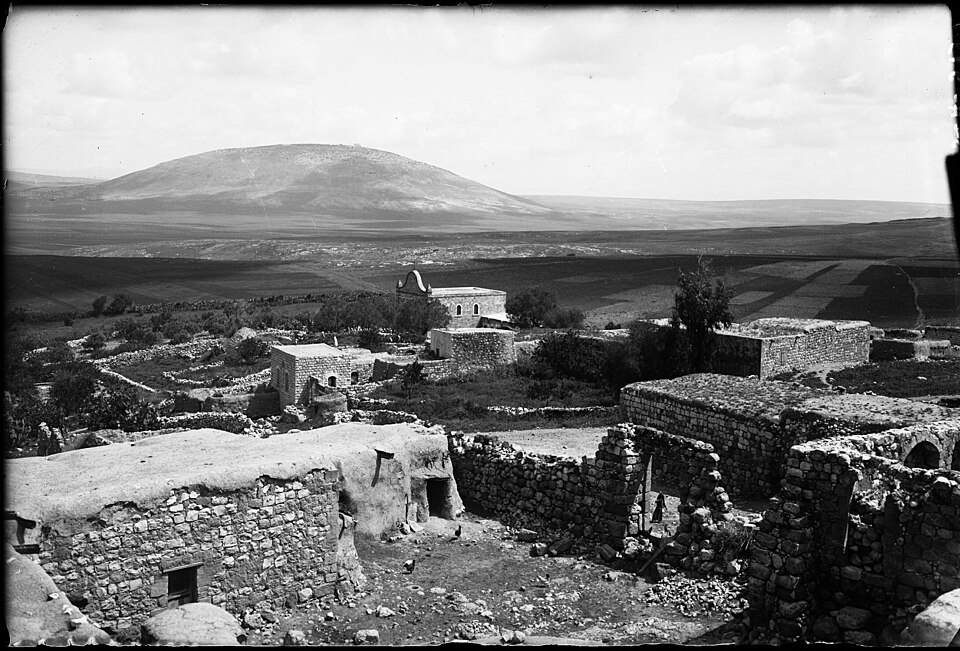
Nain is the village of Nein in Lower Galilee, at the northern foot of the hill of Moreh, about 9 km south-east of Nazareth, looking across the valley to Mount Tabor. Endor lies about 4 km to the east, and Shunem on the far side of the same hill. The old name has survived, and the identification is generally accepted.
Small salvage excavations in the modern village have found building remains of the Late Bronze Age, pottery of the Roman period and, from the Byzantine period, a pool paved with white mosaic and several winepresses. Surveys of the neighbouring site by the spring of En ha-Moreh recorded rock-cut tombs and pottery from the Early Bronze Age to the Iron Age.
Nain is named only in the Gospel of Luke. Jesus came there with his disciples and much people, and near the gate of the city met a funeral: the dead man was "the only son of his mother, and she was a widow". He had compassion on her, touched the bier and said, "Young man, I say unto thee, Arise." The dead man sat up and began to speak, and the people glorified God, saying "That a great prophet is risen up among us". The scene is often compared with Elisha's raising of the son of a woman of Shunem, on the other side of the hill.
In the early fourth century Eusebius placed Nain south of Mount Tabor near Endor; his Greek text gives the distance as twelve miles, Jerome's Latin version as two. Jerome writes that when Paula climbed Tabor in the 380s, the town of Nain, where the widow's son was raised, was pointed out to her close by. The Byzantine finds show that the village was still lived in during the fifth and sixth centuries.
Scripture: Luke 7:11–17; 2 Kgs 4:8; 2 Kgs 4:32–37
Sources
- Eusebius, Onomasticon, s.v. Naein (C. U. Wolf's translation, no. 750); s.v. Endor (no. 476)
- Jerome, Letter 108.13
- A. Mokary, 'Nein', Hadashot Arkheologiyot 121 (2009) (Late Bronze Age remains)
- E. Dalali-Amos, 'Nein', Hadashot Arkheologiyot 126 (2014) (Byzantine pool, fifth-sixth centuries)
- K. Covello-Paran, 'Nein-En Ha-More (N)', Hadashot Arkheologiyot 122 (earlier surveys of the site)
- E. Robinson and E. Smith, Biblical Researches in Palestine, vol. 3 (1841), p. 226 (the identification)
Checked against its sources; not yet read by a historian.
Verses (1)
- Luke 7:11
- And it came to pass the day after, that he went into a city called Nain; and many of his disciples went with him, and much people.
King James Version