 History Globe
town or village
Philippi
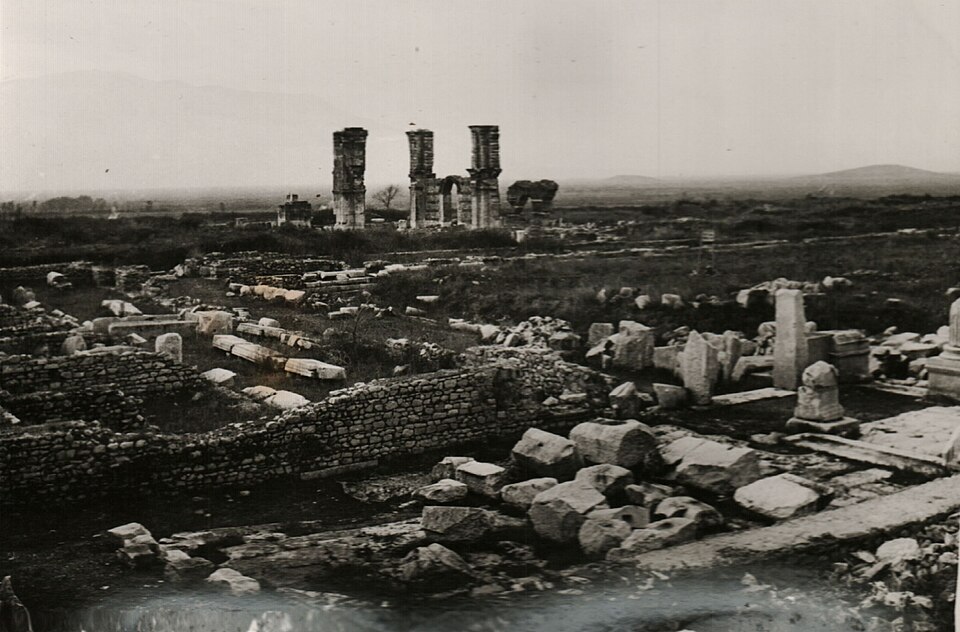
Lifetime: c. 360 BC – …
Settled by Thasos as Krenides and refounded by Philip II of Macedon, who named it after himself (356 BC).
Events
- 42 BCAntony and Octavian defeat Brutus and Cassius at Philippi
In ancient writers
- Diodorus Siculus, Library of History 16.8.6 — Philip came to Crenides, enlarged it with many settlers and renamed it Philippi after himself; he so improved its meagre gold mines that they brought him over a thousand talents a year.
- Appian, Civil Wars 4.105–106 — Philippi, formerly Datus and before that Crenides for its many springs, was fortified by Philip against the Thracians; it sits on a steep hill with woods to the north, a marsh to the south and a fertile plain to the Strymon.
Questions
History
Philippi lies in eastern Macedonia, about 15 km inland from its port Neapolis (modern Kavala), on a hill above a fertile plain rich in springs and near gold mines. About 360 BC settlers from the island of Thasos founded a town here called Crenides, "the springs". Philip II of Macedon soon took it, enlarged it, named it after himself and worked its gold mines so well that, Diodorus says, they brought him more than a thousand talents.
In 42 BC the plain beside the city saw the battles in which Antony and Octavian defeated Brutus and Cassius, the murderers of Julius Caesar; both took their own lives. Philippi then became a Roman colony on the Via Egnatia, the road across the Balkans, and after his victory at Actium Octavian settled here Italians whose land he had given to his veterans. Most of its public inscriptions were written in Latin.
Paul, Silas and their companions sailed from Troas to Neapolis and came to Philippi, which Acts calls "the chief city of that part of Macedonia, and a colony". On the sabbath they went out to a place of prayer by a river, where Lydia, a seller of purple from Thyatira, believed and was baptised with her household. When Paul drove a spirit of divination out of a slave girl, her masters dragged him and Silas before the magistrates, who had them beaten and imprisoned. At midnight an earthquake opened the prison; the jailer was baptised, and in the morning the magistrates, hearing that the two were Roman citizens, came and asked them to leave. The church at Philippi sent Paul gifts more than once. His letter to it, written from prison (in Rome, Ephesus or Caesarea; this is disputed), greets its bishops and deacons.
Paul passed through Philippi again on his last journey to Jerusalem. In the first half of the second century, most probably, Polycarp of Smyrna wrote to the Philippians, reminding them that Paul had taught among them and written to them. In the fourth century the Christians of Philippi built a church dedicated to Paul, and about AD 500 a large basilica rose on the terrace above the forum.
Scripture: Acts 16:11–15; Acts 16:16–24; Acts 16:25–40; Acts 20:6; 1 Thess 2:2; Phil 1:1; Phil 1:13; Phil 4:15–18
Sources
- Diodorus Siculus, Library 16.3.7; 16.8.6-7
- Appian, Civil Wars 4.105-131
- Cassius Dio, Roman History 51.4.6
- Polycarp, Letter to the Philippians 3.2
- P. Lemerle, Philippes et la Macédoine orientale à l'époque chrétienne et byzantine (1945)
- P. Pilhofer, Philippi I: Die erste christliche Gemeinde Europas (1995)
- C. Bakirtzis and H. Koester (eds.), Philippi at the Time of Paul and after His Death (1998)
Checked against its sources; not yet read by a historian.
Verses (4)
- Acts 16:12
- And from thence to Philippi, which is the chief city of that part of Macedonia, and a colony: and we were in that city abiding certain days.
- Acts 20:6
- And we sailed away from Philippi after the days of unleavened bread, and came unto them to Troas in five days; where we abode seven days.
- Phil 1:1
- Paul and Timotheus, the servants of Jesus Christ, to all the saints in Christ Jesus which are at Philippi, with the bishops and deacons:
- 1 Thess 2:2
- But even after that we had suffered before, and were shamefully entreated, as ye know, at Philippi, we were bold in our God to speak unto you the gospel of God with much contention.
King James Version