 History Globe
town or village
Troas
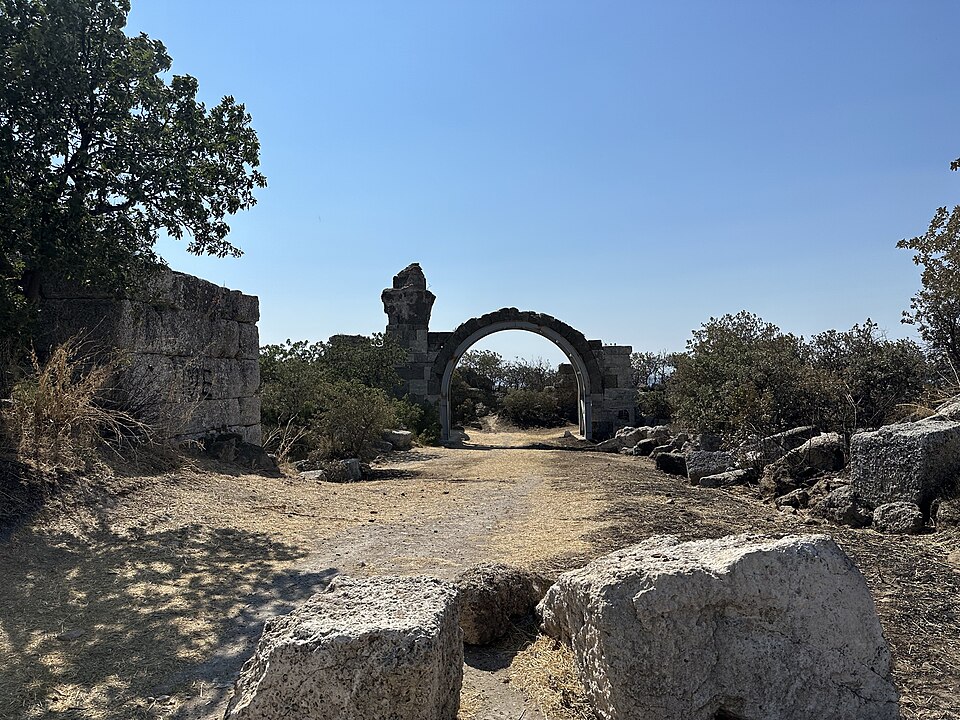
- Today Ruins of Alexandria Troas, by Dalyan
Lifetime: c. 310 BC – …
Founded by Antigonus as Antigonia and renamed Alexandria Troas by Lysimachus.
History
Troas, in full Alexandria Troas, lay on the Aegean coast of the Troad in north-west Asia Minor, opposite the island of Tenedos and about 25 km south of Troy. Antigonus founded it late in the fourth century BC as Antigonia, on a site called Sigia, and brought in the people of nearby towns such as Neandria and Cebren. Lysimachus, who held the region after 301 BC, renamed it Alexandria in honour of Alexander. Strabo says it endured and grew, received a colony of Romans and was one of the notable cities of the world.
Under Augustus the city became a Roman colony, and it was the chief harbour for the crossing from Asia to Macedonia. The circuit of its walls, the remains of baths and a theatre, and the silted basins of its harbour can still be traced.
On his second journey Paul, passing by Mysia, came down to Troas. There in the night he saw a man of Macedonia praying him, "Come over into Macedonia, and help us", and the company sailed straight to Samothracia and Neapolis; here Acts begins to speak of "we". Later Paul came to Troas to preach the gospel and found a door opened, but went on to Macedonia because Titus was not there. On his last journey to Jerusalem he stayed seven days: on the first day of the week, when the disciples came together to break bread, he spoke until midnight, and the young man Eutychus fell from the third loft and was taken up dead, but was brought alive. The Second Letter to Timothy, written in Paul's name, asks for the cloak left at Troas with Carpus.
Early in the second century, by the usual dating, Ignatius of Antioch, taken under guard to Rome, wrote from Troas his letters to the Philadelphians, to the Smyrnaeans and to Polycarp, and sailed from there to Neapolis. Under Hadrian, Philostratus tells, Herodes Atticus, then in charge of the free cities of Asia, gave the city a costly water supply. Zosimus says that Constantine first began to build his new capital between Troas and old Ilium, then left the work unfinished and chose Byzantium.
Scripture: Acts 16:8–11; 2 Cor 2:12–13; Acts 20:5–12; 2 Tim 4:13
Sources
- Strabo, Geography 13.1.26 (Antigonia renamed Alexandreia; the Roman colony); 13.1.47 (Sigia; Neandria and Cebren incorporated)
- Ignatius, Letters to the Philadelphians 11.2, to the Smyrnaeans 12.1 and to Polycarp 8.1
- Philostratus, Lives of the Sophists 2.1 (548)
- Zosimus, New History 2.30.1
- J. M. Cook, The Troad: An Archaeological and Topographical Study (1973)
- S. Feuser, Der Hafen von Alexandria Troas (Asia Minor Studien 63, 2009)
Checked against its sources; not yet read by a historian.
Verses (6)
- Acts 16:8
- And they passing by Mysia came down to Troas.
- Acts 16:11
- Therefore loosing from Troas, we came with a straight course to Samothracia, and the next day to Neapolis;
- Acts 20:5
- These going before tarried for us at Troas.
- Acts 20:6
- And we sailed away from Philippi after the days of unleavened bread, and came unto them to Troas in five days; where we abode seven days.
- 2 Cor 2:12
- Furthermore, when I came to Troas to preach Christ’s gospel, and a door was opened unto me of the Lord,
- 2 Tim 4:13
- The cloke that I left at Troas with Carpus, when thou comest, bring with thee, and the books, but especially the parchments.
King James Version