 History Globe
town or village
Rome
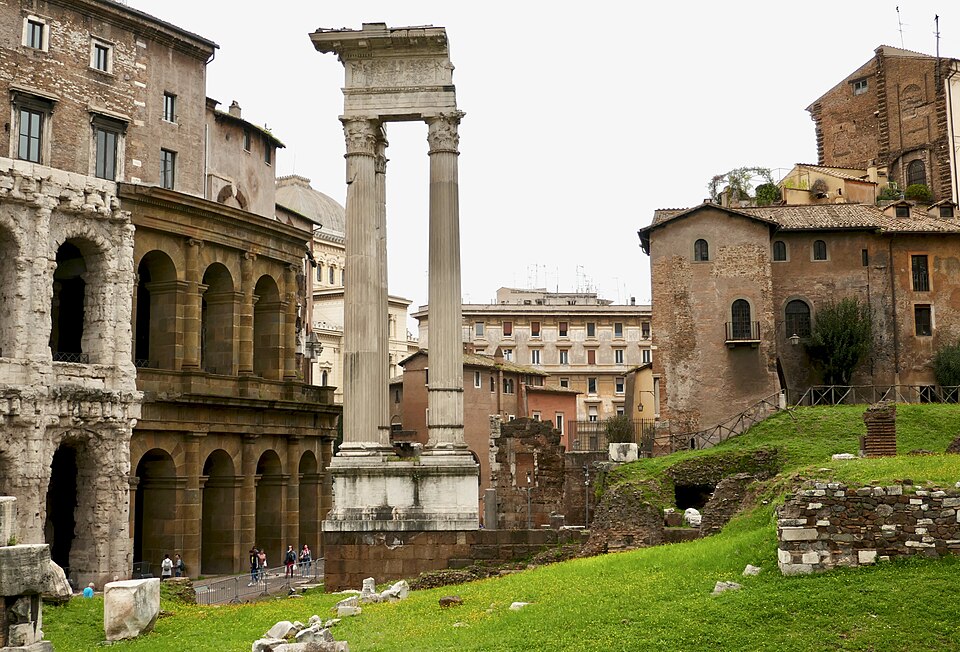
Lifetime: c. 753 BC – …
Varro's traditional date of the founding of Rome; the Palatine was settled from the 10th–9th centuries BC, so the year is conventional.
Events
- c. 161 BCJudas Maccabeus makes a treaty of friendship with Rome
- 44 BCConspirators murder Julius Caesar in Rome
- 40 BCThe Roman Senate declares Herod king of Judea
- 27 BCThe Senate names Octavian Augustus
- AD 14Tiberius succeeds Augustus
- AD 41Claudius is proclaimed emperor
- c. AD 49Claudius expels the Jews from Rome
- AD 64The fire of Rome; Nero persecutes the Christians
- c. AD 81The Senate raises the Arch of Titus in Rome, showing the spoils of the Temple
- c. AD 93Josephus completes the Jewish Antiquities in Rome
- c. AD 144Marcion breaks with the church at Rome
- c. AD 165The prefect Rusticus has Justin Martyr executed in Rome
- AD 312Constantine defeats Maxentius at the Milvian Bridge
- AD 391Theodosius forbids sacrifices and the visiting of temples in Rome
- AD 410Alaric's Visigoths sack Rome
- AD 455Gaiseric's Vandals sack Rome
- AD 590Gregory the Great becomes bishop of Rome
- AD 800Pope Leo III crowns Charlemagne emperor in Rome
In ancient writers
- Strabo, Geography 5.3.8 — The Romans excelled where the Greeks cared little: paved roads, aqueducts and sewers large enough for hay wagons; water flows through the city like rivers and nearly every house has pipes and fountains, thanks largely to Agrippa.
- Tacitus, Annals 15.44 — To quash the rumour that he had ordered the fire of AD 64, Nero blamed the Christians, named after Christus who was executed under Tiberius by Pontius Pilate; a vast multitude in Rome was torn by dogs, crucified or burned.
- Suetonius, Life of Claudius 25.4 — Since the Jews constantly made disturbances at the instigation of Chrestus, Claudius expelled them from Rome; Acts 18:2 tells of the same decree, which brought Aquila and Priscilla to Corinth.
History
Rome lies on the Tiber, about 25 km from the sea, where low hills overlook a crossing of the river. Huts stood on the Palatine from the tenth and ninth centuries BC; Roman tradition put the founding by Romulus in 753 BC, a conventional year. Kings ruled until, traditionally, 509 BC, when the Romans drove out Tarquin and set up a republic. Early in the fourth century BC the Gauls sacked the city.
The republic united Italy and then, in wars with Carthage and the Hellenistic kings, the Mediterranean; in 146 BC it destroyed both Carthage and Corinth. Pompey took Jerusalem in 63 BC; Jews brought to Italy as captives and later freed made up much of Rome's Jewish community. After the civil wars Augustus became the first emperor in 27 BC and rebuilt the city in marble. Rome now held hundreds of thousands of people, perhaps a million; the figure is disputed.
Visitors from Rome heard Peter at Pentecost. About AD 49 Claudius expelled the Jews from Rome, and Aquila and Priscilla came to Corinth. Paul wrote to the Romans, a church he had not yet seen, and arrived as a prisoner about AD 60; he lived two whole years in his own hired house, preaching. After the fire of AD 64 Nero blamed the Christians and put many to death, as Tacitus records. Early tradition holds that Peter and Paul were martyred in Rome under Nero, and their tombs were shown on the Vatican hill and the road to Ostia.
After centuries of intermittent persecution Constantine defeated Maxentius at the Milvian Bridge in 312 and founded the Lateran basilica and St Peter's. In 330 he made Constantinople the new capital. About 382 Bishop Damasus asked Jerome to revise the Latin Gospels. Alaric's Visigoths sacked Rome in 410 and the Vandals in 455; Pope Leo I led the church from 440 to 461. In 476 Odoacer deposed Romulus Augustulus, the last emperor in the West.
Scripture: Acts 2:10; Acts 2:14; Acts 18:2; Rom 1:7; Rom 1:13; Acts 28:14–16; Acts 28:30–31
Sources
- Varronian era, as in Plutarch, Romulus 12, and Censorinus, De die natali 21
- Livy, History of Rome 1.57-60 (the end of the kings); 5.38-49 (the Gallic sack)
- Polybius, Histories 38.19-22 (Carthage); Pausanias, Description of Greece 7.16.7-10 (Corinth)
- Tacitus, Histories 5.9 (Pompey in Jerusalem); Philo, Embassy to Gaius 155 (the Jews of Rome descended from captives); Suetonius, Augustus 28.3
- Suetonius, Claudius 25.4; Orosius, History against the Pagans 7.6.15
- Tacitus, Annals 15.38-44
- 1 Clement 5; Eusebius, Church History 2.25.5-8 (Gaius on the tombs of the apostles)
- Eusebius, Life of Constantine 1.37-38; Jerome, Letter to Damasus (preface to the Gospels)
- Orosius, History against the Pagans 7.39-40; Augustine, The City of God 1.1-7; Procopius, Vandal War 1.5
- R. Krautheimer, Rome: Profile of a City, 312-1308 (1980)
- M. Beard, SPQR: A History of Ancient Rome (2015)
- P. Lampe, From Paul to Valentinus: Christians at Rome in the First Two Centuries (2003)
Checked against its sources; not yet read by a historian.
Verses (15)
- Acts 2:10
- Phrygia, and Pamphylia, in Egypt, and in the parts of Libya about Cyrene, and strangers of Rome, Jews and proselytes,
- Acts 18:2
- And found a certain Jew named Aquila, born in Pontus, lately come from Italy, with his wife Priscilla; (because that Claudius had commanded all Jews to depart from Rome:) and came unto them.
- Acts 19:21
- After these things were ended, Paul purposed in the spirit, when he had passed through Macedonia and Achaia, to go to Jerusalem, saying, After I have been there, I must also see Rome.
- Acts 19:40
- For we are in danger to be called in question for this day’s uproar, there being no cause whereby we may give an account of this concourse.
- Acts 23:11
- And the night following the Lord stood by him, and said, Be of good cheer, Paul: for as thou hast testified of me in Jerusalem, so must thou bear witness also at Rome.
- Acts 25:25
- But when I found that he had committed nothing worthy of death, and that he himself hath appealed to Augustus, I have determined to send him.
- Acts 25:27
- For it seemeth to me unreasonable to send a prisoner, and not withal to signify the crimes laid against him.
- Acts 28:14
- Where we found brethren, and were desired to tarry with them seven days: and so we went toward Rome.
- Acts 28:15
- And from thence, when the brethren heard of us, they came to meet us as far as Appii forum, and The three taverns: whom when Paul saw, he thanked God, and took courage.
- Acts 28:16
- And when we came to Rome, the centurion delivered the prisoners to the captain of the guard: but Paul was suffered to dwell by himself with a soldier that kept him.
- Acts 28:30
- And Paul dwelt two whole years in his own hired house, and received all that came in unto him,
- Rom 1:7
- To all that be in Rome, beloved of God, called to be saints: Grace to you and peace from God our Father, and the Lord Jesus Christ.
- Rom 1:15
- So, as much as in me is, I am ready to preach the gospel to you that are at Rome also.
- Rom 15:24
- Whensoever I take my journey into Spain, I will come to you: for I trust to see you in my journey, and to be brought on my way thitherward by you, if first I be somewhat filled with your company.
- 2 Tim 1:17
- But, when he was in Rome, he sought me out very diligently, and found me.
King James Version