 History Globe
town or village
Salamis
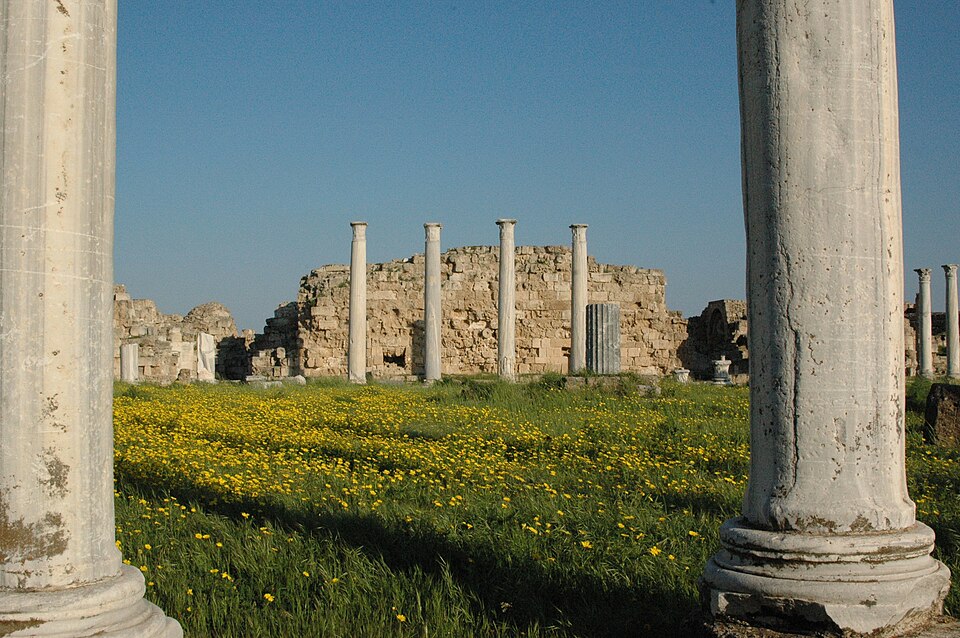
Lifetime: … – c. AD 650
Rebuilt as Constantia after the earthquakes of the 4th century; abandoned after the Arab raids under Mu'awiya in the 7th century, its people moving to Famagusta.
In ancient writers
- Strabo, Geography 14.6.3 — On the beach of the Achaeans Teucer, banished by his father Telamon, first landed and founded Salamis in Cyprus; Salamis was the birthplace of the historian Aristus.
- Diodorus Siculus, Library of History 20.47.2–3 — In 306 BC Demetrius landed in Cyprus and marched on Salamis; Ptolemy's general Menelaus met him forty stades out with 12,000 foot and 800 horse, was routed and driven back into the city, losing some 3,000 prisoners.
History
Salamis lay on the east coast of Cyprus at the mouth of the Pediaeus river, about 6 km north of modern Famagusta. Greek legend made Teucer, son of Telamon, its founder after the Trojan War; archaeology traces the town to the eleventh century BC, when it took over from the older harbour town at nearby Enkomi. Its cemetery holds the so-called royal tombs of the eighth and seventh centuries BC, with chariots, sacrificed horses and rich goods from Egypt and Syria. About 673 BC the Assyrian king Esarhaddon named Kisu, king of Salamis, among ten kings of Cyprus whom he summoned for his building work at Nineveh, in the same list as Manasseh, king of Judah.
Under Persian rule Salamis was the leading Greek kingdom of the island; its king Evagoras I, praised by Isocrates, reigned from about 411 to 374 BC and waged a long war against Persia. In 306 BC Demetrius, son of Antigonus, besieged the city and destroyed the fleet of Ptolemy I off its shore. Under the later Ptolemies and under Rome the seat of government passed to Paphos, but Salamis remained the island's largest city, with a theatre, a gymnasium and a temple of Zeus.
Barnabas, one of the leaders of the church at Antioch, was a Levite of Cyprus. Sent out with Saul, he sailed from Seleucia to the island, and at Salamis, the first stop of the journey, they preached the word of God in the synagogues of the Jews, with John Mark to help them. After parting from Paul, Barnabas took Mark and sailed again to Cyprus. A later legend, the Acts of Barnabas, tells that he was martyred at Salamis.
In the Jewish revolt of 116–117 under Trajan the Jews of Cyprus rose under Artemion; Jerome's Chronicle says they overthrew Salamis after killing its gentile inhabitants, and Cassius Dio reports that afterwards no Jew might set foot on the island. In the fourth century earthquakes ruined the city, and Constantius II rebuilt it as Constantia, which became the capital of Cyprus. Its bishop Epiphanius, from about 367 to 403, wrote a great work against all heresies.
Scripture: Acts 4:36; Acts 13:1–5; Acts 15:39
Sources
- Strabo, Geography 14.6.3 (Teucer as founder)
- Esarhaddon, Nineveh prism A (RINAP 4, Esarhaddon 1) v 54-72: the ten kings of Cyprus
- Isocrates, Evagoras (Oration 9)
- Diodorus Siculus, Library 20.47-53 (siege of Salamis and the sea battle of 306 BC)
- Cassius Dio, Roman History 68.32; Jerome, Chronicle (entry on the destruction of Salamis, c. AD 117)
- Acts of Barnabas (fifth-century legend of his martyrdom at Salamis)
- Jerome, On Illustrious Men 114 (Epiphanius, bishop of Salamis)
- V. Karageorghis, Salamis in Cyprus: Homeric, Hellenistic and Roman (1969)
- T. B. Mitford, 'Roman Cyprus', ANRW II.7.2 (1980)
Checked against its sources; not yet read by a historian.
Verses (1)
- Acts 13:5
- And when they were at Salamis, they preached the word of God in the synagogues of the Jews: and they had also John to their minister.
King James Version