 History Globe
town or village
Thebes
- Today Luxor
Events
- c. 2055 BCMentuhotep II becomes king at Thebes: the start of the Middle Kingdom
- c. 1156 BCThe workmen of the royal tombs at Thebes strike over unpaid rations
- c. 663 BCAshurbanipal sacks Thebes (No-Amon)
In ancient writers
- Homer, Iliad 9.381–384 — Achilles cites the wealth of Egyptian Thebes, where the greatest treasures lie stored in men's houses, a city of a hundred gates through each of which two hundred warriors sally forth with horses and chariots.
- Strabo, Geography 17.1.46 — Thebes, now called Diospolis, is Homer's city of a hundred gates and great wealth, and other writers call it the metropolis of Egypt; vestiges of its size still stretch 80 stades, and villages now occupy the site.
- Tacitus, Annals 2.60 — In AD 19 Germanicus visited the vast ruins of ancient Thebes; an aged priest read him the hieroglyphs recording 700,000 men of military age, King Rhamses' conquests, and tributes as magnificent as Parthia or Rome now exact.
History
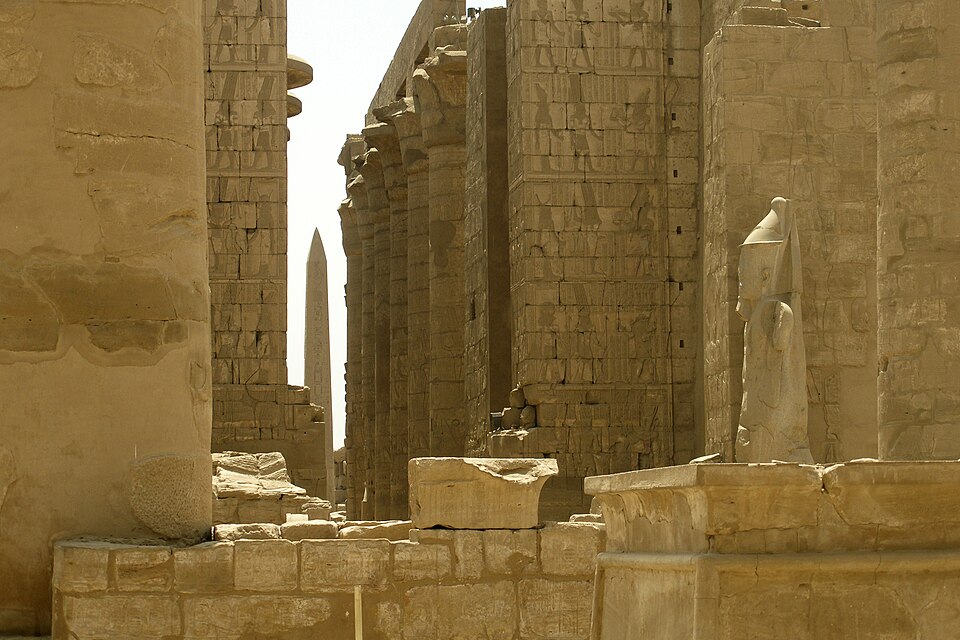
Thebes stood on both banks of the Nile in Upper Egypt, about 500 km south of Cairo, where Luxor is today. The Egyptians called it Waset, the Greeks Thebes, and the Hebrew Bible No or No-Amon, the city of Amun. It was a provincial town until its princes of the Eleventh Dynasty reunited Egypt under Mentuhotep II in the twenty-first century BC. From then on Amun of Thebes rose to be the chief god of the land, and king after king enlarged his temple at Karnak for some two thousand years.
In the New Kingdom (c. 1550–1070 BC) Thebes was the religious capital of an empire. Its kings built the temples of Karnak and Luxor on the east bank and their mortuary temples on the west, among them Hatshepsut's at Deir el-Bahari, and were buried in the Valley of the Kings, where Howard Carter found the tomb of Tutankhamun in 1922. Homer speaks of Egyptian Thebes as the richest city in the world, with a hundred gates.
In 664 or 663 BC the Assyrian king Ashurbanipal pursued the Kushite king Tanutamon to Thebes, took the city and carried off its treasures, among them two obelisks. Nahum reminds Nineveh of that fall: "Art thou better than populous No ... Yet was she carried away, she went into captivity." Jeremiah foretold that God would punish the multitude of No together with Pharaoh, and Ezekiel that he would execute judgments in No.
Under the Ptolemies Thebes rebelled more than once; in the 80s BC Ptolemy IX put down a revolt so harshly, Pausanias says, that no trace of its old prosperity was left. Strabo found only a group of villages. An earthquake, usually dated 27 BC, had broken one of the two colossi of Amenhotep III; the broken statue was said to give out a sound once a day, and Roman visitors came to hear it and carved their names and verses on it; the emperor Hadrian came in AD 130. In late antiquity Christian monks settled in the old tombs and temples.
Scripture: Jer 46:25; Ezek 30:14–16; Nah 3:8–10
Sources
- Homer, Iliad 9.381-384
- Ashurbanipal's Rassam Cylinder (RINAP 5, Ashurbanipal 11) ii 22-48
- Pausanias, Description of Greece 1.9.3
- Strabo, Geography 17.1.46 (Thebes in villages; the colossus)
- A. and É. Bernand, Les inscriptions grecques et latines du Colosse de Memnon (1960)
- I. Shaw (ed.), The Oxford History of Ancient Egypt (2000)
- N. Strudwick and H. Strudwick, Thebes in Egypt (1999)
Checked against its sources; not yet read by a historian.
Verses (6)
- Jer 46:25
- The LORD of hosts, the God of Israel, saith; Behold, I will punish the multitude of No, and Pharaoh, and Egypt, with their gods, and their kings; even Pharaoh, and all them that trust in him:
- Ezek 30:14
- And I will make Pathros desolate, and will set fire in Zoan, and will execute judgments in No.
- Ezek 30:15
- And I will pour my fury upon Sin, the strength of Egypt; and I will cut off the multitude of No.
- Ezek 30:16
- And I will set fire in Egypt: Sin shall have great pain, and No shall be rent asunder, and Noph shall have distresses daily.
- Nah 3:8
- Art thou better than populous No, that was situate among the rivers, that had the waters round about it, whose rampart was the sea, and her wall was from the sea?
- Nah 3:10
- Yet was she carried away, she went into captivity: her young children also were dashed in pieces at the top of all the streets: and they cast lots for her honourable men, and all her great men were bound in chains.
King James Version