 History Globe
town or village
Timnah
- Today Tel Batash
History
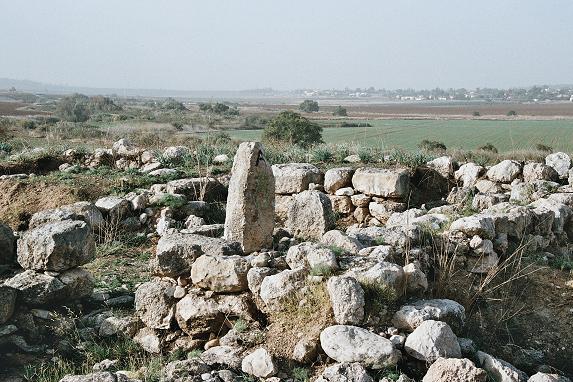
Timnah, the Timnath of Samson's story, is identified with Tel Batash, a mound on the flat floor of the Sorek valley between Beth-shemesh and Ekron. The Book of Joshua runs the border of Judah from Beth-shemesh past Timnah to the north side of Ekron, and Tel Batash lies on that line, downstream from Beth-shemesh and a few kilometres from Ekron (Tel Miqne). Amihai Mazar and George L. Kelm excavated the site in 1977–1989. It is a different place from Timnath-serah, Joshua's town in the hills of Ephraim.
The town was founded in the Middle Bronze Age, about 1750–1550 BC, within earthen ramparts. In the Late Bronze Age a large two-storey house stood there, and a burnt layer of the fourteenth century BC held cylinder seals and scarabs of Amenhotep III and Queen Tiye. In the twelfth and eleventh centuries BC Philistine pottery and seals show a Philistine town. After a gap a stone wall and a gate were built in the eighth century BC; a jar handle stamped lmlk, the royal stamp of Judah, was found, though the household pottery is closer to that of the coast. In the seventh century the town prospered, with a citadel and olive-oil presses. Like Ekron, it was destroyed about 600 BC, probably by the Babylonians, and the mound was abandoned in the Persian period.
In the Book of Joshua Timnah stands on the northern border of Judah and is listed among the towns of Dan. "Samson went down to Timnath, and saw a woman in Timnath of the daughters of the Philistines." On the way, at the vineyards of Timnath, he tore apart a young lion, and at the wedding feast he put his riddle to thirty companions. When his wife was given to another man, he set the Philistines' harvest on fire with foxes, and the Philistines burned her in revenge. Under Ahaz the Philistines took Timnah and its villages from Judah. In 701 BC Sennacherib of Assyria records that he besieged, conquered and plundered Eltekeh and Tamna before he dealt with Ekron.
No town rose on the mound again, and the name Timnah seems to have passed to Khirbet Tibna, a few kilometres away. In the early fourth century AD Eusebius refers Samson's Thamnatha to Thamna, which he describes as a very large village in the territory of Diospolis (Lod), halfway to Jerusalem; he gives the Philistine town no site of its own.
Scripture: Josh 15:10–11; Josh 19:43; Judg 14:1–2; Judg 14:5–6; Judg 14:10–18; Judg 14:20; Judg 15:1–6; 2 Chr 28:18
Sources
- Sennacherib, annals: RINAP 3, Sennacherib 22 (Chicago prism) iii 6; Sennacherib 4 (Rassam cylinder), line 46 (Eltekeh and Tamna)
- Eusebius, Onomasticon, s.v. Thamna and Thamnatha (C. U. Wolf's translation, nos. 487 and 507)
- G. L. Kelm and A. Mazar, 'Three Seasons of Excavations at Tel Batash: Biblical Timnah', BASOR 248 (1982), pp. 1-36
- A. Mazar, Timnah (Tel Batash) I: Stratigraphy and Architecture (Qedem 37, 1997); A. Mazar and N. Panitz-Cohen, Timnah (Tel Batash) II: The Finds from the First Millennium BCE (Qedem 42, 2001)
- G. L. Kelm and A. Mazar, Timnah: A Biblical City in the Sorek Valley (1995)
Checked against its sources; not yet read by a historian.
Verses (9)
- Josh 15:10
- And the border compassed from Baalah westward unto mount Seir, and passed along unto the side of mount Jearim, which is Chesalon, on the north side, and went down to Beth-shemesh, and passed on to Timnah:
- Josh 19:43
- And Elon, and Thimnathah, and Ekron,
- Judg 14:1
- And Samson went down to Timnath, and saw a woman in Timnath of the daughters of the Philistines.
- Judg 14:2
- And he came up, and told his father and his mother, and said, I have seen a woman in Timnath of the daughters of the Philistines: now therefore get her for me to wife.
- Judg 14:5
- Then went Samson down, and his father and his mother, to Timnath, and came to the vineyards of Timnath: and, behold, a young lion roared against him.
- Judg 14:7
- And he went down, and talked with the woman; and she pleased Samson well.
- Judg 14:8
- And after a time he returned to take her, and he turned aside to see the carcase of the lion: and, behold, there was a swarm of bees and honey in the carcase of the lion.
- Judg 15:6
- Then the Philistines said, Who hath done this? And they answered, Samson, the son in law of the Timnite, because he had taken his wife, and given her to his companion. And the Philistines came up, and burnt her and her father with fire.
- 2 Chr 28:18
- The Philistines also had invaded the cities of the low country, and of the south of Judah, and had taken Beth-shemesh, and Ajalon, and Gederoth, and Shocho with the villages thereof, and Timnah with the villages thereof, Gimzo also and the villages thereof: and they dwelt there.
King James Version