 History Globe
town or village
Caesarea Philippi
- Today Banias
Lifetime: c. 3 BC – …
Founded by Philip the Tetrarch at the sanctuary of Pan (Panias) as his capital and named after Caesar.
Battles and sieges
- 200 BCBattle of Panium: Judea passes to the Seleucids
Antiochus III against the Ptolemaic army under Scopas. Scopas is defeated; Coele-Syria and Judea pass from the Ptolemies to the Seleucids.
Questions
History
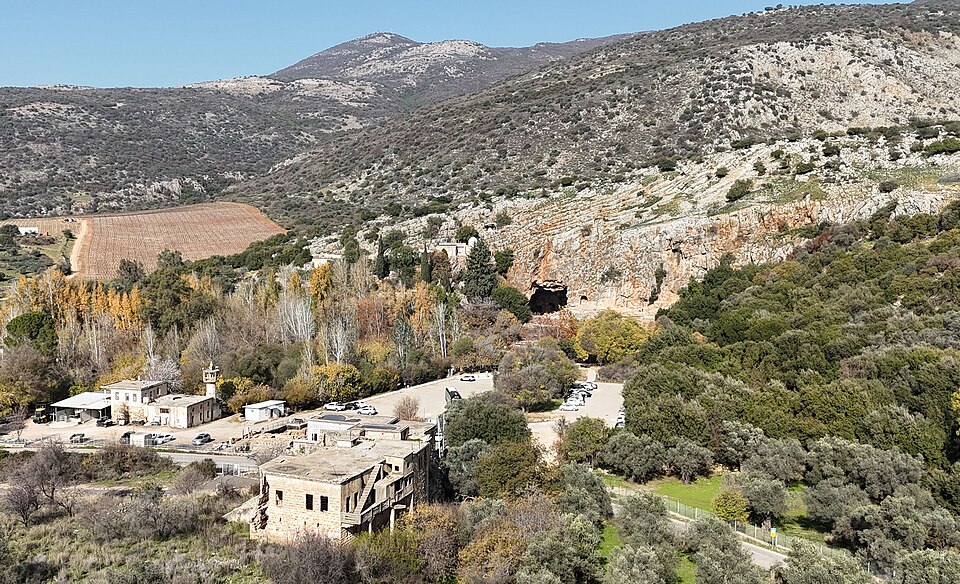
Caesarea Philippi lay at the southern foot of Mount Hermon, where one of the main springs of the Jordan flows out from below a cliff and a large cave; the site is today's Banias in the Golan Heights. In the Hellenistic age the cave was sacred to the Greek god Pan, and the place was called the Panium or Paneas. About 200 BC Antiochus III defeated the Ptolemaic general Scopas near the Panium, and the land passed from the Ptolemies to the Seleucids.
In 20 BC Augustus gave Herod the Great the territory of Zenodorus, which included Paneas, and Herod built a temple of white stone to Augustus near the Panium. Where it stood is disputed: some place it in front of the cave, others at Omrit, a few kilometres to the south-west. Around 3 BC Herod's son Philip the tetrarch built a city at the springs as his capital and named it Caesarea; it was called Caesarea Philippi to tell it from Caesarea on the coast.
When Jesus came "into the coasts of Caesarea Philippi", he asked his disciples whom men said that he was, and Peter answered, "Thou art the Christ, the Son of the living God." In Matthew, Jesus then says to him, "thou art Peter, and upon this rock I will build my church", and promises him the keys of the kingdom of heaven. Mark tells the same exchange on the way to the towns of Caesarea Philippi.
King Agrippa II enlarged the city and renamed it Neronias in honour of Nero. In AD 67 Vespasian rested his army there for twenty days as Agrippa's guest, and in 70, after the fall of Jerusalem, Titus held games there in which many Jewish captives were killed. The city later went by the name of Paneas again. Eusebius saw there a bronze statue said to show the woman healed of an issue of blood kneeling before Jesus; Sozomen reports that under Julian it was pulled down and replaced by a statue of the emperor.
Scripture: Matt 16:13–20; Mark 8:27–30; Matt 9:20–22
Sources
- Polybius, Histories 16.18 (the battle at the Panium)
- Josephus, Antiquities 15.360; 15.363-364; 18.28; 20.211; Jewish War 1.404-406; 2.168; 3.443-444; 3.509-513; 7.23-24
- Eusebius, Ecclesiastical History 7.17-18
- Sozomen, Church History 5.21
- Z. U. Ma'oz, V. Tzaferis and M. Hartal, 'Banias', in The New Encyclopedia of Archaeological Excavations in the Holy Land 1 (1993) and 5 (2008)
- J. F. Wilson, Caesarea Philippi: Banias, the Lost City of Pan (2004)
Checked against its sources; not yet read by a historian.
Verses (2)
- Matt 16:13
- When Jesus came into the coasts of Caesarea Philippi, he asked his disciples, saying, Whom do men say that I the Son of man am?
- Mark 8:27
- And Jesus went out, and his disciples, into the towns of Cæsarea Philippi: and by the way he asked his disciples, saying unto them, Whom do men say that I am?
King James Version