 History Globe
town or village
Emmaus
- Today Qalunya
- Location disputed
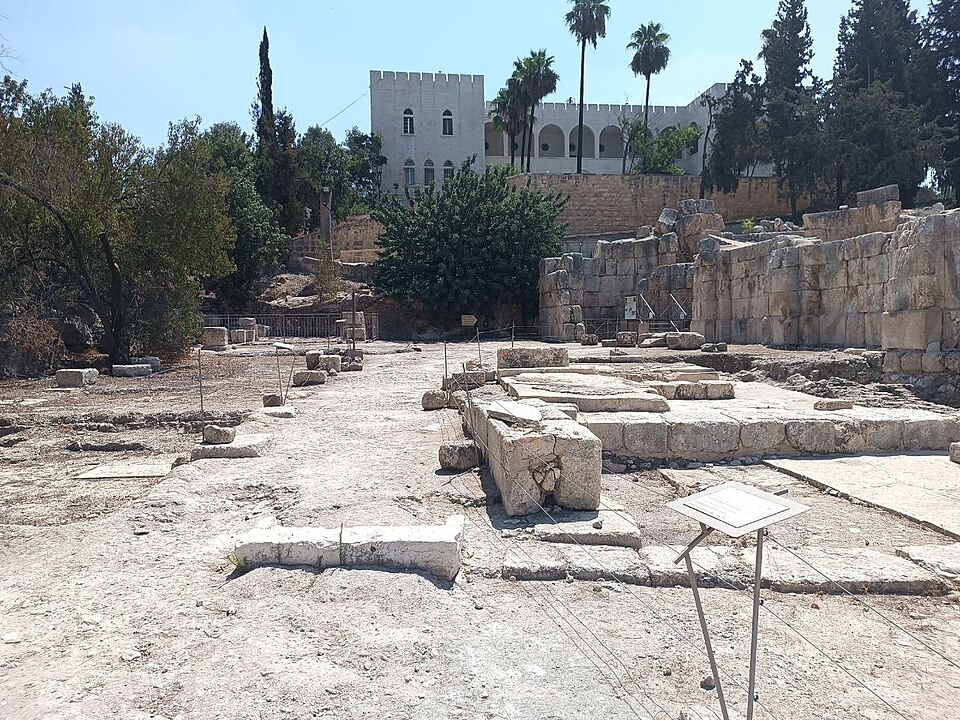
Photo: Peace be with you (איתם שלום), CC BY 2.5, Wikimedia Commons
Questions
History
Emmaus is the village to which two disciples walked on the day of the resurrection, "a village called Emmaus, which was from Jerusalem about threescore furlongs". Its site is disputed. Most manuscripts of Luke give sixty stadia, about 11 km; some, among them Codex Sinaiticus, give 160, about 30 km. Four places are most often named: Emmaus-Nicopolis (Imwas) near Latrun, the Emmaus of the ancient church; Abu Ghosh on the road west to the coast, held to be Emmaus from the twelfth century; el-Qubeibeh to the north-west, so held from the later Middle Ages; and Motza, west of Jerusalem, where the map point stands.
Emmaus-Nicopolis lay where the road from the coastal plain begins to climb towards Jerusalem, and it was the Emmaus of the Maccabean and Roman wars. About 165 BC Judas Maccabeus defeated a Seleucid army camped there. In 43 BC Cassius sold its people into slavery when the levy he demanded was slow to come in, and in 4 BC the Roman governor Varus burned the town after its inhabitants had fled.
In Luke's account one of the two travellers is named Cleopas. Jesus joined them on the road unrecognised and opened the Scriptures to them. At the village they urged him to stay, "for it is toward evening, and the day is far spent"; as he blessed and broke the bread "their eyes were opened, and they knew him; and he vanished out of their sight". The same hour they returned to Jerusalem and found the eleven.
In AD 68 Vespasian camped at Emmaus and left the Fifth Legion there. After the war, Josephus says, he gave land to 800 discharged soldiers at a place called Ammaus, 30 stadia from Jerusalem in the standard Greek text (some manuscripts read 60); many identify it with Motza, the Mozah of Joshua's list, whose later name Qalunya is thought to recall the Latin colonia. About 221 Emmaus-Nicopolis became a city named Nicopolis after an embassy led by Julius Africanus. Eusebius took it for the home of Cleopas, and Jerome, telling of Paula's visit in the 380s, writes that the Lord, known there in the breaking of bread, made the house of Cleopas a church. Remains of a Byzantine church still stand at Imwas.
Scripture: Luke 24:13–18; Luke 24:28–31; Luke 24:33–35; Josh 18:26
Sources
- Codex Sinaiticus and other witnesses for 160 stadia at Luke 24:13 (B. M. Metzger, A Textual Commentary on the Greek New Testament, 1971, on Luke 24:13)
- Josephus, Antiquities 12.298-312 (Judas and Gorgias at Emmaus); 14.275 and Jewish War 1.222 (Cassius); Antiquities 17.291 and Jewish War 2.71 (Varus)
- Josephus, Jewish War 4.444-445 (Vespasian and the Fifth Legion); 7.217 (Ammaus, 30 stadia in Niese's text, 60 in other manuscripts)
- Jerome, Chronicle (Nicopolis founded, Julius Africanus' embassy, c. AD 221); Letter 108.8
- Eusebius, Onomasticon, s.v. Emmaous (C. U. Wolf's translation, no. 457)
- D. Pringle, The Churches of the Crusader Kingdom of Jerusalem, vol. 1 (1993), nos. 1 (Abu Ghosh) and 10 ('Amwas)
- L.-H. Vincent and F.-M. Abel, Emmaüs, sa basilique et son histoire (1932)
Checked against its sources; not yet read by a historian.
Verses (3)
- Luke 24:13
- And, behold, two of them went that same day to a village called Emmaus, which was from Jerusalem about threescore furlongs.
- Luke 24:28
- And they drew nigh unto the village, whither they went: and he made as though he would have gone further.
- Luke 24:35
- And they told what things were done in the way, and how he was known of them in breaking of bread.
King James Version