 History Globe
town or village
Hamath
- Today Hama
History
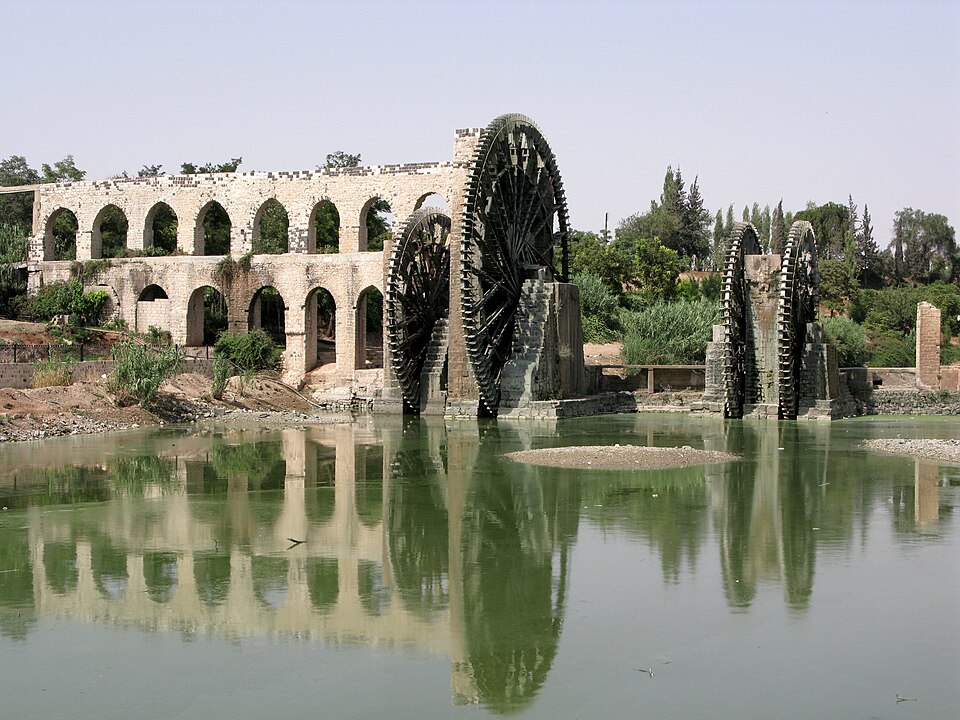
Hamath is the city of Hama in western Syria, on the river Orontes. Its great mound, the old citadel, was excavated by a Danish expedition in the 1930s under Harald Ingholt, which found settlement reaching back to prehistoric times. In the Iron Age Hamath was the capital of a kingdom in central Syria. Its ninth-century kings left inscriptions in Luwian hieroglyphs, and a later king, Zakkur, king of Hamath and Lu'ash, wrote in Aramaic on a stele of how Bar-Hadad son of Hazael and his allies besieged him at Hazrak, early in the eighth century BC.
In 2 Samuel, Toi, king of Hamath, sent his son Joram with gifts to David after David had defeated Hadadezer, and 2 Chronicles says that Solomon built store cities in Hamath. In 853 BC Irhuleni of Hamath and Adad-idri of Damascus led the coalition, Ahab of Israel among them, that met Shalmaneser III at Qarqar, a royal city of Hamath. 2 Kings says that Jeroboam II recovered Hamath for Israel, and Amos calls it "Hamath the great". In the 730s BC Eni-il of Hamath paid tribute to Tiglath-pileser III.
In 720 BC Ilu-bi'di of Hamath stirred up Arpad, Simirra, Damascus and Samaria against Assyria. Sargon II defeated him at Qarqar, flayed him and took chariots and horsemen of Hamath into his own army. 2 Kings tells how the king of Assyria settled men of Hamath in the cities of Samaria, and how the Rabshakeh asked the people of Jerusalem, "Where are the gods of Hamath, and of Arpad?" Riblah, in the land of Hamath, later served as the camp of conquerors: there Pharaoh Necho put Jehoahaz in bonds, and there Nebuchadnezzar judged Zedekiah. In 605 BC, the Babylonian Chronicle says, Nebuchadnezzar's troops overtook the Egyptians fleeing from Carchemish in the district of Hamath and conquered the whole area.
Under the Seleucid kings the city was renamed Epiphania, usually taken to honour Antiochus IV Epiphanes; Josephus notes that its people still called it Amathe. Early in the fourth century Eusebius suggested that the Hamath of Isaiah and Amos was perhaps Epiphania near Emesa. It remained a city of Roman and Byzantine Syria, and after the Arab conquest in the seventh century its old name, Hama, came back into use.
Scripture: 2 Sam 8:9–10; 2 Chr 8:4; 2 Kgs 14:28; Amos 6:2; 2 Kgs 17:24; 2 Kgs 18:34; 2 Kgs 23:33; 2 Kgs 25:6–7; Jer 39:5
Sources
- The Zakkur Stele (KAI 202)
- Shalmaneser III, Kurkh Monolith (D. D. Luckenbill, Ancient Records of Assyria and Babylonia I, 610-611: Irhuleni of Hamath at Qarqar, 853 BC)
- Tiglath-pileser III, RINAP 1, Tiglath-pileser III 14 line 10 (tribute of Eni-il of Hamath; the city name is partly restored)
- Sargon II, Khorsabad Annals (RINAP 2, Sargon II 1) lines 23-25; Great Display Inscription (RINAP 2, Sargon II 7) lines 33-36 (Ilu-bi'di, 720 BC)
- Babylonian Chronicle ABC 5 (Jerusalem Chronicle) obv. 5-8
- Josephus, Antiquities 1.138 (Amathe, called Epiphania by the Macedonians)
- Eusebius, Onomasticon, s.v. Emath ('perhaps Epiphania near Emesa', Wolf no. 451); the Coele Syria remark under Aimath is Jerome's addition
- H. Ingholt, Rapport préliminaire sur sept campagnes de fouilles à Hama en Syrie (1932-1938) (1940)
- J. D. Hawkins, Corpus of Hieroglyphic Luwian Inscriptions I: Inscriptions of the Iron Age (2000)
- T. Bryce, The World of the Neo-Hittite Kingdoms (2012)
Checked against its sources; not yet read by a historian.
Verses (21)
- 2 Sam 8:9
- When Toi king of Hamath heard that David had smitten all the host of Hadadezer,
- 2 Kgs 14:28
- Now the rest of the acts of Jeroboam, and all that he did, and his might, how he warred, and how he recovered Damascus, and Hamath, which belonged to Judah, for Israel, are they not written in the book of the chronicles of the kings of Israel?
- 2 Kgs 18:34
- Where are the gods of Hamath, and of Arpad? where are the gods of Sepharvaim, Hena, and Ivah? have they delivered Samaria out of mine hand?
- 2 Kgs 19:13
- Where is the king of Hamath, and the king of Arpad, and the king of the city of Sepharvaim, of Hena, and Ivah?
- 2 Kgs 23:33
- And Pharaoh-nechoh put him in bands at Riblah in the land of Hamath, that he might not reign in Jerusalem; and put the land to a tribute of an hundred talents of silver, and a talent of gold.
- 2 Kgs 25:21
- And the king of Babylon smote them, and slew them at Riblah in the land of Hamath. So Judah was carried away out of their land.
- 1 Chr 18:9
- Now when Tou king of Hamath heard how David had smitten all the host of Hadarezer king of Zobah;
- 2 Chr 8:4
- And he built Tadmor in the wilderness, and all the store cities, which he built in Hamath.
- Isa 10:9
- Is not Calno as Carchemish? is not Hamath as Arpad? is not Samaria as Damascus?
- Isa 11:11
- And it shall come to pass in that day, that the Lord shall set his hand again the second time to recover the remnant of his people, which shall be left, from Assyria, and from Egypt, and from Pathros, and from Cush, and from Elam, and from Shinar, and from Hamath, and from the islands of the sea.
- Isa 36:19
- Where are the gods of Hamath and Arphad? where are the gods of Sepharvaim? and have they delivered Samaria out of my hand?
- Isa 37:13
- Where is the king of Hamath, and the king of Arphad, and the king of the city of Sepharvaim, Hena, and Ivah?
- Jer 39:5
- But the Chaldeans’ army pursued after them, and overtook Zedekiah in the plains of Jericho: and when they had taken him, they brought him up to Nebuchadnezzar king of Babylon to Riblah in the land of Hamath, where he gave judgment upon him.
- Jer 49:23
- Concerning Damascus. Hamath is confounded, and Arpad: for they have heard evil tidings: they are fainthearted; there is sorrow on the sea; it cannot be quiet.
- Jer 52:9
- Then they took the king, and carried him up unto the king of Babylon to Riblah in the land of Hamath; where he gave judgment upon him.
- Jer 52:27
- And the king of Babylon smote them, and put them to death in Riblah in the land of Hamath. Thus Judah was carried away captive out of his own land.
- Ezek 47:16
- Hamath, Berothah, Sibraim, which is between the border of Damascus and the border of Hamath; Hazar-hatticon, which is by the coast of Hauran.
- Ezek 47:17
- And the border from the sea shall be Hazar-enan, the border of Damascus, and the north northward, and the border of Hamath. And this is the north side.
- Ezek 48:1
- Now these are the names of the tribes. From the north end to the coast of the way of Hethlon, as one goeth to Hamath, Hazar-enan, the border of Damascus northward, to the coast of Hamath; for these are his sides east and west; a portion for Dan.
- Amos 6:2
- Pass ye unto Calneh, and see; and from thence go ye to Hamath the great: then go down to Gath of the Philistines: be they better than these kingdoms? or their border greater than your border?
- Zech 9:2
- And Hamath also shall border thereby; Tyrus, and Zidon, though it be very wise.
King James Version