 History Globe
town or village
Perga
History
Perga lay in Pamphylia, on the coastal plain of southern Asia Minor some 15 km north-east of modern Antalya, near the river Cestrus, now the Aksu; Strabo says one sailed sixty stadia up the river to reach it. Its acropolis was already inhabited in prehistoric times, and a Hittite treaty of the thirteenth century BC names a town Parha on the western border of Tarhuntassa, usually identified with Perga. The Pamphylians themselves told that their forefathers had come from Troy with Amphilochus and Calchas.
Alexander the Great marched through Perga in the winter of 334–333 BC, sending part of his army there by a mountain road. On a height near the city stood the temple of Artemis of Perga, where a festival was held every year, and the goddess and her temple appeared on the city's coins. The mathematician Apollonius, who wrote on conic sections in the third century BC, was born here.
Paul and his company sailed from Paphos to Perga in Pamphylia, and there John Mark left them and returned to Jerusalem, a departure that later parted Paul and Barnabas. From Perga they went inland to Antioch in Pisidia. On the way back they preached the word in Perga, went down to the port of Attalia and sailed from there to Antioch in Syria.
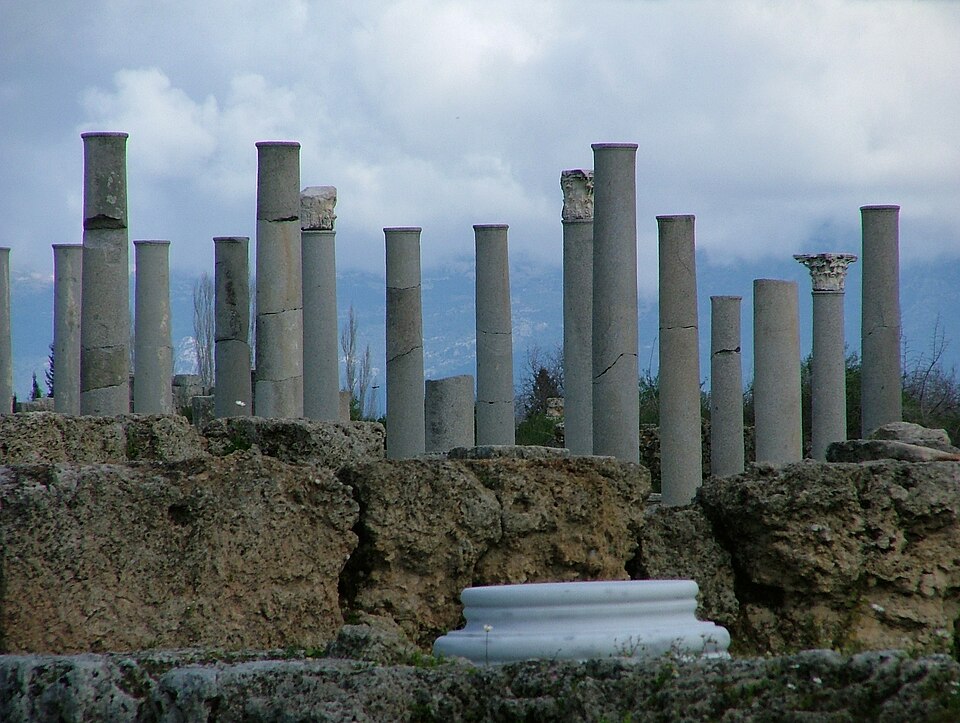
Under the Roman empire Perga grew rich. In the early second century the priestess Plancia Magna, daughter of a Roman governor, rebuilt the Hellenistic south gate as a grand courtyard with statues of the city's founders and of the imperial family. The city had a theatre, a stadium, baths and a colonnaded main street with a water channel running down its middle. In late antiquity it was a bishop's see with large churches. Excavations by Istanbul University since 1946 have uncovered much of the city.
Scripture: Acts 13:13–14; Acts 14:24–26; Acts 15:37–39
Sources
- Strabo, Geography 14.4.2-3 (the Cestrus, Perga and the temple of Artemis; the Pamphylians from Troy)
- The Bronze Tablet from Hattusa, treaty of Tudhaliya IV with Kurunta of Tarhuntassa (Parha)
- Arrian, Anabasis of Alexander 1.26.1; 1.27.5
- G. E. Bean, Turkey's Southern Shore: An Archaeological Guide (1968)
- M. T. Boatwright, 'Plancia Magna of Perge: Women's Roles and Status in Roman Asia Minor', in S. B. Pomeroy (ed.), Women's History and Ancient History (1991)
Checked against its sources; not yet read by a historian.
Verses (3)
- Acts 13:13
- Now when Paul and his company loosed from Paphos, they came to Perga in Pamphylia: and John departing from them returned to Jerusalem.
- Acts 13:14
- But when they departed from Perga, they came to Antioch in Pisidia, and went into the synagogue on the sabbath day, and sat down.
- Acts 14:25
- And when they had preached the word in Perga, they went down into Attalia:
King James Version