 History Globe
town or village
Pergamum
- Today Pergamon
Events
- 133 BCAttalus III bequeaths the kingdom of Pergamum to Rome
In ancient writers
- Strabo, Geography 13.4.1–2 — Pergamum, a city of note that flourished long under the Attalid kings, was embellished by Eumenes with the grove and offerings of the Nicephorium and a library; the last Attalus left the kingdom to the Romans.
- Pliny the Elder, Natural History 13.70 — When King Ptolemy, rivalling King Eumenes over their libraries, banned the export of papyrus, parchment was invented at Pergamum, as Varro relates.
History
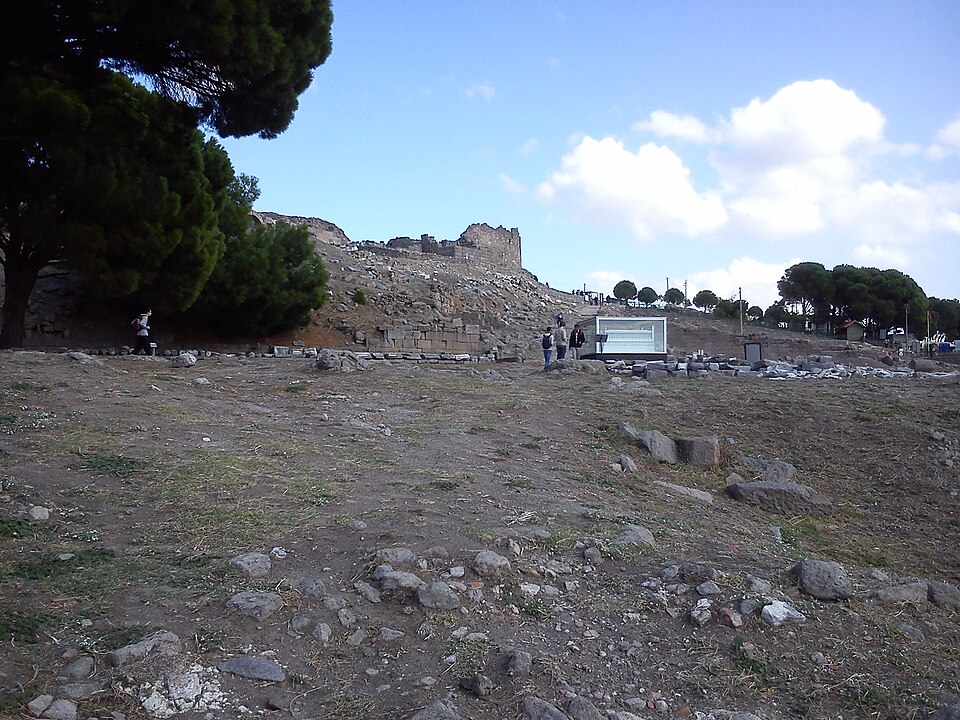
Pergamum, by modern Bergama, stands on a steep hill above the fertile valley of the Caicus in north-western Asia Minor, some 25 km from the Aegean. Xenophon's Greek army came to it about 400 BC, but its rise came after Alexander. Lysimachus kept a treasure of nine thousand talents in its citadel under the eunuch Philetaerus, who broke with him about 282 BC and kept the city and the treasure; his heirs, the Attalids, made it a kingdom, and Attalus I took the title of king after a great victory over the Galatians.
The Attalids sided with Rome. Eumenes II (197–159 BC) received from the Romans the lands of Asia Minor taken from Antiochus the Great, and Pergamum was adorned with temples, libraries and the great altar, usually dated to his reign. Pliny, following Varro, tells that parchment was invented here when the king of Egypt, jealous of Pergamum's library, stopped the export of papyrus. In 133 BC Attalus III died and left his kingdom to the Romans, who made it the province of Asia.
In 29 BC Augustus allowed the Greeks of Asia to build a temple to himself and Rome at Pergamum. The city was also famed for its sanctuary of Asclepius, the healing god, and the physician Galen was born here about AD 129. Revelation addresses the third of the seven churches to Pergamum, "where Satan's seat is", and names Antipas, "my faithful martyr, who was slain among you". Whether Satan's seat means the altar of Zeus, the worship of the emperor or the city's place as a seat of Roman power is disputed. The letter also rebukes those who hold the teaching of Balaam and of the Nicolaitans.
Eusebius records that Carpus, Papylus and a woman named Agathonice were martyred at Pergamum; their death is dated by some to the reign of Marcus Aurelius and by others to that of Decius. In 262, the Historia Augusta says, an earthquake struck the cities of Asia hardest of all, and Gothic raiders then ravaged the province; it does not name Pergamum, but the city never regained its Attalid splendour. The Red Basilica, a huge second-century temple of Egyptian gods in the lower city, later had a church built inside it.
Scripture: Rev 1:11; Rev 2:12–17
Sources
- Xenophon, Anabasis 7.8.8
- Strabo, Geography 13.4.1-2
- Pliny the Elder, Natural History 13.70 (after Varro)
- Cassius Dio, Roman History 51.20.6-7; Tacitus, Annals 4.37; 4.55
- Eusebius, Church History 4.15.48
- Historia Augusta, The Two Gallieni 5.2-6.2
- Altertümer von Pergamon (German excavation reports, 1885-)
- E. V. Hansen, The Attalids of Pergamon (2nd ed., 1971)
- H. Koester (ed.), Pergamon, Citadel of the Gods (1998)
Checked against its sources; not yet read by a historian.
Verses (2)
- Rev 1:11
- Saying, I am Alpha and Omega, the first and the last: and, What thou seest, write in a book, and send it unto the seven churches which are in Asia; unto Ephesus, and unto Smyrna, and unto Pergamos, and unto Thyatira, and unto Sardis, and unto Philadelphia, and unto Laodicea.
- Rev 2:12
- And to the angel of the church in Pergamos write; These things saith he which hath the sharp sword with two edges;
King James Version